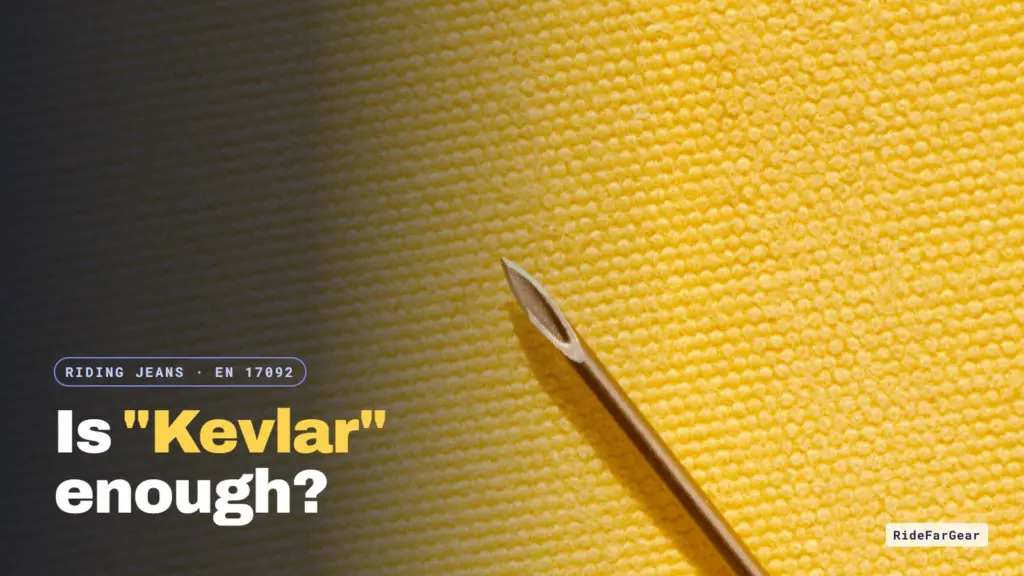
Some Kevlar riding jeans are genuinely protective. Most are not, and the word “Kevlar” on the label will not tell you which pair you are holding.
That is not an opinion. It is what an independent test program found when it tested fabric from 126 pairs of denim riding pants on an abrasion rig.
How 126 denim riding pants scored for abrasion
MotoCAP abrasion score out of 10, number of products in each band
Every denim pant MotoCAP rates, including older ratings, counted with its own filters in October 2026. The median score was 1 out of 10. For comparison, the 27 leather pants had a median of 7.
scored 2 or less
Out of 10, for abrasion.
with “Kevlar” in the name
Also scored 2 or less.
scored 7 or more
So good riding denim exists.
Before you read on
- “Kevlar” names a fiber, not a level of protection. How much there is, and where, decides the result.
- Most denim riding pants score poorly in independent abrasion tests. A few score very well.
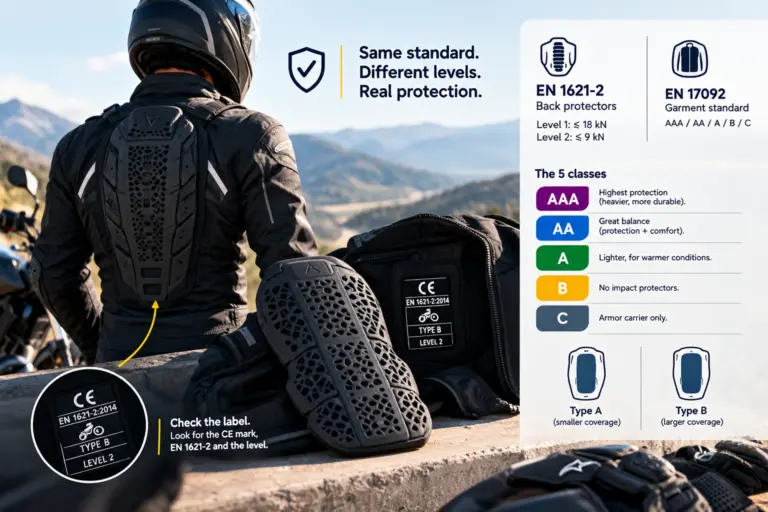
- Look for an EN 17092 class on the label. AA or AAA is a real step up from A.
- Class B means no armor. Budget for knee and hip protectors.
- Check MotoCAP if your pair has been tested. It ranks protection, where the label only says pass.
- Fit decides whether the armor works: the knee protector must sit on your knee when seated.
Contents
What “Kevlar” means on riding jeans
Kevlar is DuPont’s brand name for a para-aramid fiber, which is why many labels just say “aramid”. It is very strong for its weight and resists heat, and that is why it ended up in riding gear.
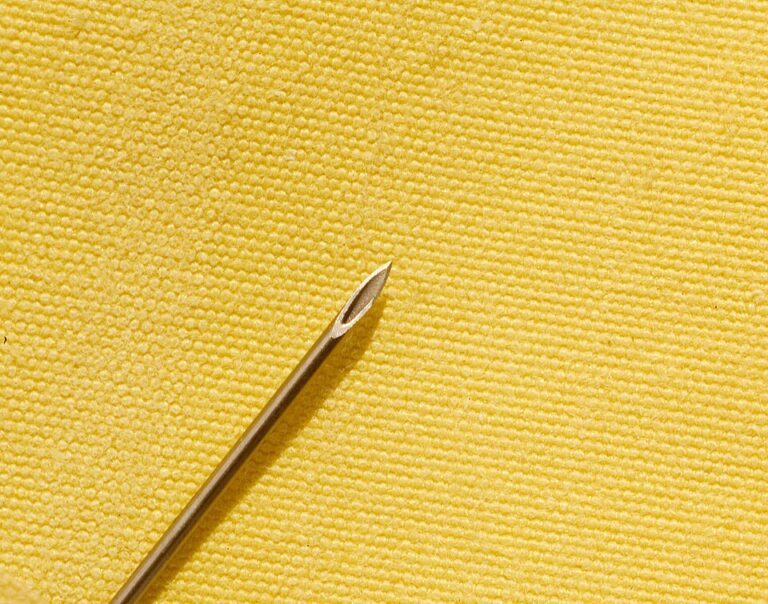
But a fiber is only an ingredient. What protects you is the construction: how much of it there is, how it is woven, and which parts of the jeans it actually covers.
TYPE 1
Aramid patches
Panels sewn inside at the seat and knees. Light and cheap. Anywhere outside the patches, you are sliding on plain denim.
TYPE 2
Full aramid lining
A second layer covering most of the legs. More coverage, but heavier and warmer than normal jeans.
TYPE 3
Single-layer denim
The strong fiber is woven into the denim itself, often UHMWPE such as Dyneema rather than aramid. No liner, so cooler to wear.
Single-layer denim now reaches the top classes. Knox lists its Shield jeans as Class AAA, and Cortech’s AA Dyneema jeans are certified AA with only 4% Dyneema in the fabric. The weave matters as much as the fiber.
Why so many riding jeans score low
The MotoCAP numbers above are not a quirk. They follow from three ways a “Kevlar” pair can come up short.
Coverage. If the aramid stops short of the areas that hit the road first, those areas are protected by denim alone. One MotoCAP report notes a pair’s high-risk zones were tested mostly on plain denim, despite an aramid liner.
Not enough of it. A thin layer of a strong fiber still wears through. The word on the label says nothing about the weight or the weave.
Seams. Gear often fails at the stitching. Strong fabric held together by weak seams still opens up in a slide.
To be fair to denim, it is not uniquely bad. Of the 131 textile pants MotoCAP rates, 121 also scored 2 or less for abrasion. Leather is the material that consistently scores well, as the comparison shows.
Abrasion scores by material: low vs high
Share of MotoCAP-rated pants scoring 2 or less and 7 or more out of 10
Denim (126 pants)
Textile (131 pants)
Leather (27 pants)
Not one leather pant scored 2 or less, and not one textile pant reached 7. Counted with MotoCAP’s own material and abrasion filters, all ratings including older ones, October 2026.
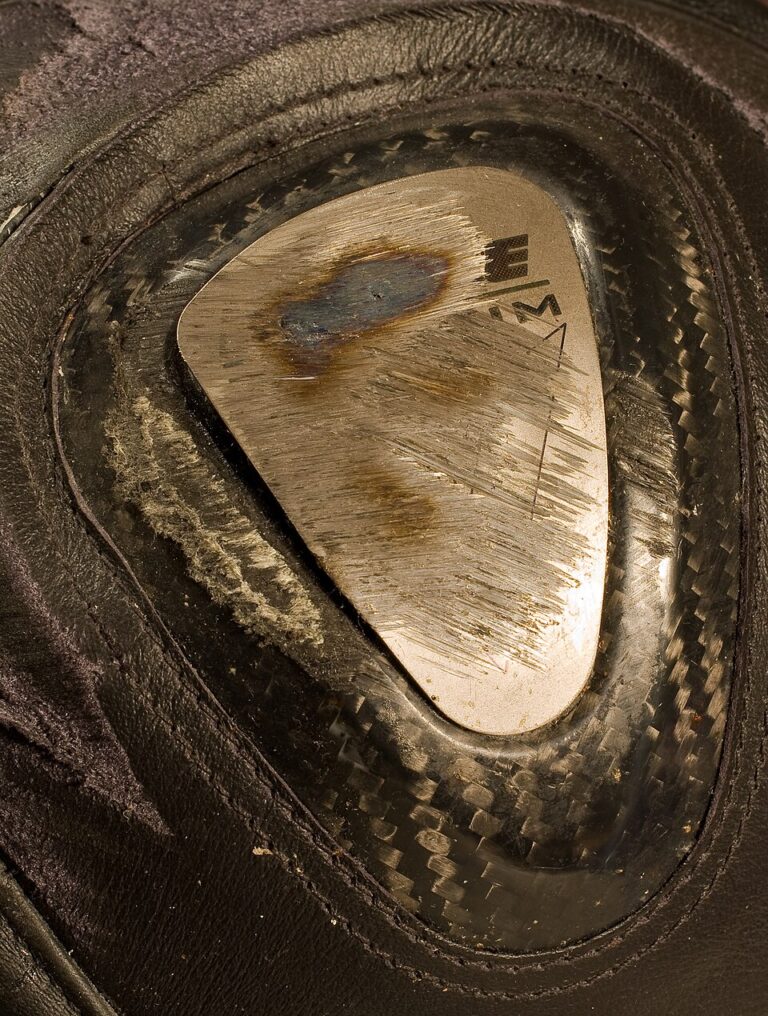
Leather’s lead comes from thickness and how it wears: it scuffs and scorches rather than opening up. The photo below shows racing leathers after a real crash at speed.
What the EN 17092 label tells you
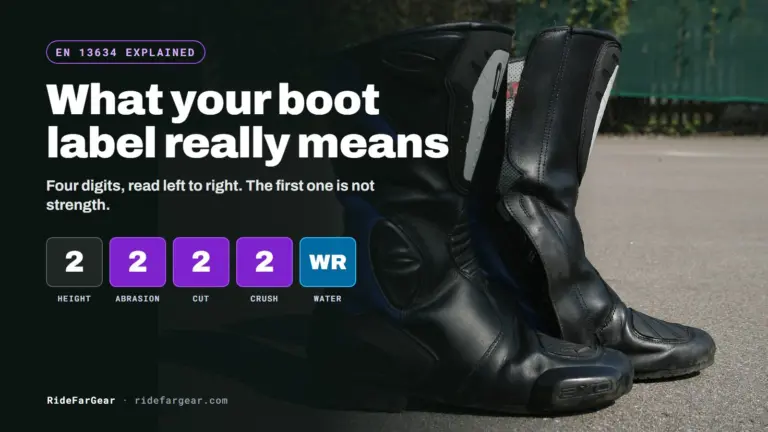
Riding jeans sold in Europe are certified to EN 17092, the same garment standard as jackets. It tests abrasion, tear and seam strength and gives a class. Look for it on the inside label. Gloves and boots carry their own standards: EN 13594 for gloves and EN 13634 for boots.
| Label says | Class | What it means for jeans |
|---|---|---|
| EN 17092-2 | AAA | The top class. Now reached by some single-layer denim |
| EN 17092-3 | AA | A real step up from A, and a good target for touring |
| EN 17092-4 | A | The entry class for gear with impact protectors. Many riding jeans sit here |
| EN 17092-5 | B | Abrasion tested, but sold without armor |
| No EN 17092 | None | “Kevlar lined” with no class is a marketing claim, not a rating |
If you want the detail behind the classes, from the risk zones to the tests, read EN 17092 explained: what AAA, AA and A mean.
The label vs MotoCAP: pass mark vs ranking
The two tell you different things. A CE class is a pass mark: the jeans met the requirements for that class. It does not say by how much.
MotoCAP ranks products against each other. It is an independent rating program in Australia and New Zealand that publishes a score for every product it tests.
How MotoCAP tests abrasion
A sample of the fabric is wrapped around a metal block and dropped onto an abrasive belt moving at a fixed speed. A thin wire behind the fabric stops the clock the moment a hole forms. The longer it lasts, the higher the score.
Deakin University, which runs the MotoCAP tests, shows the abrasion rig in action and explains why the score matters.
Its results show good denim is out there. Draggin’s Holeshot and Finn Moto’s 881 Protective scored 10 out of 10 for abrasion, and the Finn Moto 882 Protective scored 9. If your shortlist has a MotoCAP rating, it is the best evidence you will find.
Scores apply to one model, not a brand
The same maker can have one pair near the top and another near the bottom. Check the exact model and version, because construction changes between versions.
Armor and fit: the other half
Abrasion is only one way a crash hurts you. The other is impact on the knees and hips, and that is the job of the protectors, not the denim.
Classes AAA, AA and A include impact protectors. Class B does not, so check what is actually in the pockets. Some jeans ship with knee armor and an empty hip pocket, which is worth filling with a CE-rated protector.
The sitting test
Sit in a riding position. The knee armor should stay over your kneecap, not slide down your shin.
Adjustable pockets
Many riding jeans let you move the knee protector up or down. Use it: leg lengths vary more than waist sizes.
For what the CE level on a protector means, see CE Level 1 vs Level 2 armor.
How to pick a safe pair
Put it together and the checklist is short. Ignore the word Kevlar and look for evidence instead.
Before you buy riding jeans
For a second, independent look, Bennetts BikeSocial bought 12 pairs of riding jeans and had them lab tested by SATRA against a single layer of leather.
For long highway days, aim for AA or AAA, or a high MotoCAP score, whatever the material. Our comparison of mesh, leather and textile covers the same trade-offs for jackets.
How we counted
We counted abrasion scores for all 288 pants MotoCAP rates, older ratings included, using its own material and abrasion-score filters in October 2026, so anyone can repeat the count. The test description comes from MotoCAP’s own testing page.
The “Kevlar in the name” figure counts denim products whose name includes Kevlar. Class claims for Knox and Cortech come from their listings and a Rider Magazine review. We have not tested these jeans ourselves.
What riders ask about riding jeans
Are Kevlar riding jeans safe?
Some are, many are not. Of 126 denim riding pants rated by MotoCAP, 89 scored 2 or less out of 10 for abrasion, including 7 of the 9 with Kevlar in the product name. Ten scored 7 or more. Look for an EN 17092 class of AA or AAA, or a high MotoCAP score, rather than the word Kevlar.
Are riding jeans as safe as leather?
Usually not. In MotoCAP’s ratings, leather pants had a median abrasion score of 7 out of 10, against 1 for denim, and none of the 27 leather pants scored 2 or less. The best denim pants did score 9 or 10, so a well-made pair can match leather on abrasion, but they are the exception.
Which riding pants material scores best for abrasion?
Leather, by a wide margin. In MotoCAP’s ratings, 56% of leather pants scored 7 or more out of 10 for abrasion and none scored 2 or less. For denim, 8% scored 7 or more and 71% scored 2 or less. No textile pant reached 7, and 92% scored 2 or less.
What does EN 17092 A mean on jeans?
Class A is the entry class for motorcycle garments that include impact protectors. The jeans passed the abrasion, tear and seam tests for that class. AA and AAA set higher requirements. Class B means the garment was tested for abrasion but is sold without armor.
Is single-layer denim better than Kevlar-lined jeans?
Not automatically, but it can be. Single-layer jeans weave a strong fiber such as Dyneema into the denim, so there is no liner and they are cooler to wear. Some reach Class AAA, according to their makers. Compare the EN 17092 class and any MotoCAP score rather than the construction type.
Do riding jeans need armor?
Yes. Abrasion resistance does nothing for a knee or hip impact. Classes AAA, AA and A include impact protectors, while Class B jeans are sold without them. Check that both knee and hip protectors are fitted, and that the knee armor stays over your kneecap when you sit in a riding position.
What is MotoCAP?
MotoCAP is an independent safety and comfort rating program for motorcycle clothing in Australia and New Zealand. It tests abrasion, impact protection and seam burst strength, and publishes a score for each product. It is useful even outside those countries, because many brands are sold worldwide.
More on protective gear
- EN 17092 explained: what AAA, AA and A jackets mean
- What is CE-rated motorcycle armor? EN 1621 explained
- Motorcycle armor ratings explained: CE Level 1 vs Level 2
- More protective apparel guides
Abrasion scores counted with MotoCAP’s own filters; videos by Deakin University and Bennetts BikeSocial; photos via Wikimedia Commons; test method from MotoCAP; product class claims from Knox, Cortech and Rider Magazine. Always check the label and rating of the exact model you buy.