WHAT MOST RIDERS ASSUME
“If I wear earplugs, I won’t be able to hear my intercom.”
WHAT ACTUALLY HAPPENS
Earplugs turn down the wind and the speakers together. But in loud noise, your ears understand speech better when everything is quieter. Most riders find the intercom clearer with plugs in, at a lower volume.
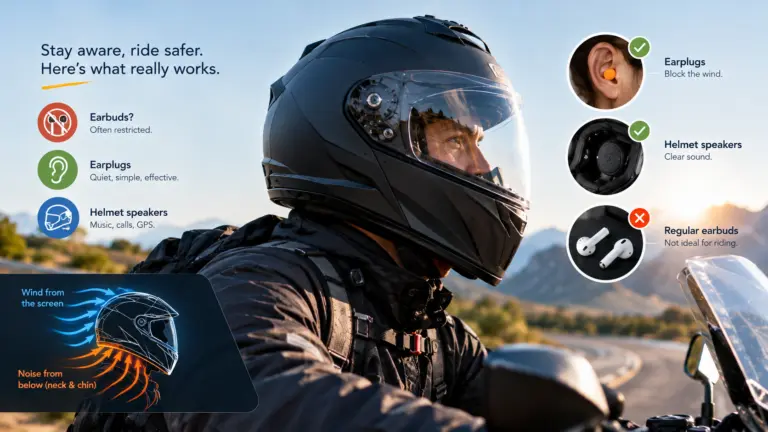
Almost any earplug works with an intercom, as long as it fits and your speakers are set up for it. The best choice depends on whether you want the cheapest fix or the most comfortable one for all-day rides.
The reason to bother is your hearing. Wind noise at highway speed is above the level that damages hearing over time, and turning the intercom up to beat it only adds to the total.
NIOSH limit for 8 hours
Above it, noise damages hearing over time.
the median helmet at 62 mph
From CRASH tests of 199 road helmets.
better speech recognition
With earplugs, in one study’s loudest test conditions.
The essentials
- Plugs and speakers work together. You hear the intercom at a lower, safer volume.
- Foam plugs block the most and cost the least. Filtered plugs sound more natural.
- Earplug speakers put the sound inside the plug, but check they are legal where you ride.
- The label NRR overstates what you get on the road. Plan on about half.
- Speaker position matters. A speaker pressing on the plug hurts within an hour.
- Turn the volume down after fitting plugs, not up.
What’s covered
How loud it really is inside a helmet
The best independent numbers come from CRASH, the helmet rating program in Australia and New Zealand. It measures noise in a wind tunnel at 100 km/h (62 mph), with a microphone inside an acoustic mannequin’s ear.
Noise inside 199 road helmets at 62 mph
CRASH wind tunnel results, number of helmets in each band. Full-face, modular, dual-sport and convertible helmets
The median helmet measured 96.2 dBA. Not one was under 90. Quietest 90.5 dBA, loudest 105.2 dBA. Counted from CRASH’s published ratings in October 2026.
Now set that against NIOSH’s limit: 85 dBA for 8 hours, with the safe time halving for every 3 dB more. Here is how long each helmet takes to use up a whole day’s allowance.
Time to reach NIOSH’s daily noise limit
At CRASH’s measured levels. Bars scaled to an 8-hour day
Without plugs, a typical helmet uses up the day’s allowance in about 36 minutes. The plugs line assumes 13 dB of real-world protection, OSHA’s estimate for an NRR 33 foam plug.
| Helmet type | Helmets tested | Median noise |
|---|---|---|
| Full-face | 125 | 95.9 dBA |
| Modular (flip-up) | 49 | 96.5 dBA |
| Convertible | 6 | 97.6 dBA |
| Dual-sport | 19 | 99.3 dBA |
| Open face with visor | 31 | 100.0 dBA |
These are lab figures at one speed, without a windscreen or a rider’s body, so your own ride will differ. But the pattern holds: dual-sport helmets ran about 3 dB louder than full-faces, which halves the safe time, and no helmet type is quiet enough on its own.
Why earplugs make the intercom clearer
An earplug cuts the wind and the speaker by roughly the same amount. So the gap between them, the thing that decides whether you can pick out a voice, stays about the same.
What changes is the overall level. In very loud noise, the ear itself starts to distort, and speech gets harder to follow. Bring the whole sound down and your ears work properly again.
The same ride, with and without plugs
Illustration of the principle, not a measurement
NO EARPLUGS
WITH EARPLUGS
Without plugs, you push the intercom to the top to compete, and your ears take both. With plugs, the same gap sits at a level your ears handle cleanly.
Research backs this up. In a study of young adults with normal hearing, earplugs made speech harder to understand in quieter noise, at 60 and 70 dB. At 80 and 90 dB, with speech no louder than the noise, they improved recognition by about 30%.
Highway wind noise inside a helmet sits in that louder range. Other studies have reached mixed results, so treat it as a strong pattern rather than a law. It matches what most riders report.
Three setups that work
SETUP 1 · START HERE
Foam plugs + helmet speakers
The cheapest way to try it. Most noise blocked, nothing to set up beyond the speakers you already have.
The catch: single-use, and the fit varies every time you put them in.
SETUP 2 · MOST NATURAL
Filtered plugs + helmet speakers
Reusable plugs with a filter that lowers sound more evenly, so voices and music sound less muffled.
The catch: they usually block less than good foam.
SETUP 3 · SOUND IN THE PLUG
Earplug speakers
Plugs with small speakers built in, wired to the intercom instead of the helmet speakers. Custom-molded versions seal best.
The catch: your intercom needs a way to connect them, and the law may treat them as earphones.
For most touring riders, setup 1 or 2 is the answer. They use the helmet speakers you already own, and the speakers sit outside the ear, which matters for the law as we explain below.
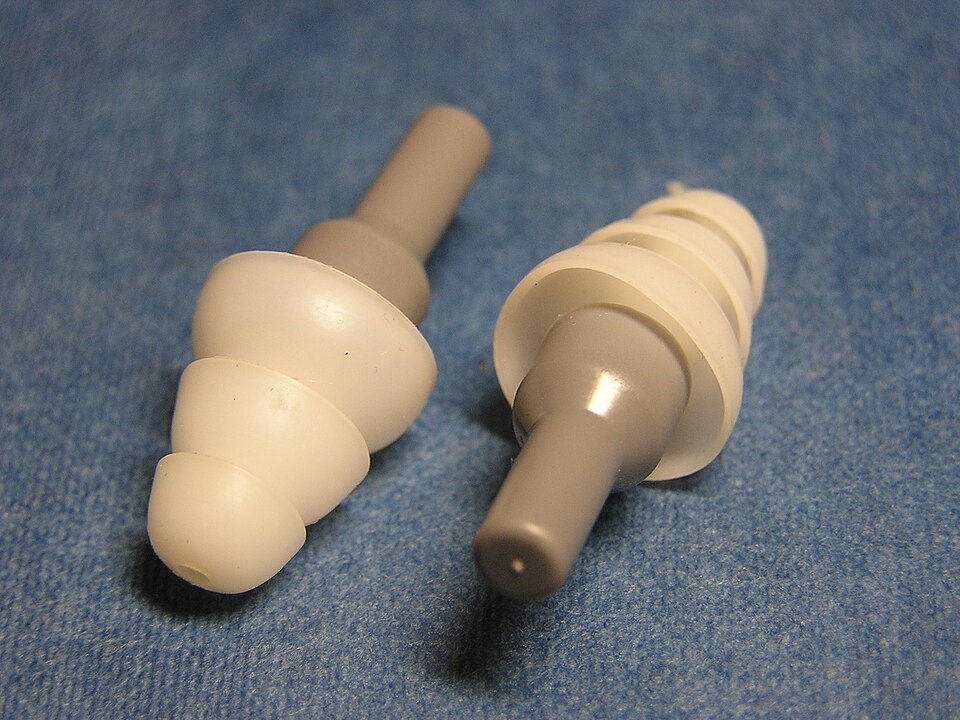
Earplug types compared
| Type | Blocks | Intercom sound | All-day comfort |
|---|---|---|---|
| Foam | Most | Muffled, needs a little more volume | Good once you learn to fit them |
| Silicone or flanged | Medium | Clear | Can press under a tight helmet |
| Filtered | Medium, more even | Most natural | Good, reusable |
| Custom-molded | Depends on the filter | Clear | Best, made for your ears |
| Earplug speakers | Depends on the seal | Directly in the ear | Good, but a cable to manage |
Comfort under a helmet is the deciding factor on long days. Anything that sticks out of the ear gets pushed in by the helmet padding, so low-profile plugs win.

What the NRR on the box really means
In the US, earplugs carry a Noise Reduction Rating. It is measured in a lab with an ideal fit, and real-world results are usually lower, sometimes much lower.
THE BOX SAYS
NRR 33
PLAN ON
About 13 dB
That conversion is OSHA’s method: subtract 7, then halve it. NIOSH uses different factors by plug type. Either way, the point stands: fit matters more than the number, so learn to put them in properly.
Fitting foam plugs: roll, pull, hold
1. Roll the plug into a thin, tight cylinder.
2. Pull the top of your ear up and back with the other hand, and slide the plug in.
3. Hold it in place while it expands.
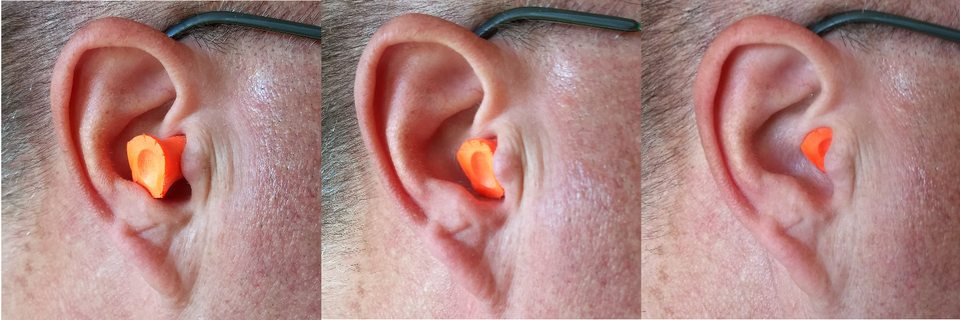
The National Institutes of Health shows the roll, pull and hold technique in a short video.
Setting up your speakers for earplugs
The most common complaint is not sound but pain. A speaker pressing on your ear pushes it against the plug, and that hurts long before the end of a riding day.
- Center each speaker over your ear canal. Put the helmet on and feel where your ear sits, then move the speaker to match.
- Leave a small gap. If the speaker presses your ear into the plug, thin the padding behind it or move it into the ear pocket.
- Fit the plugs before the helmet, and check they did not shift when the helmet went on.
- Start with the volume low, then raise it at highway speed until speech is clear. Stop there.
- Check any automatic volume feature. Some intercoms raise the volume as noise rises. With plugs in, set it lower or turn it off.
If voices still sound thin, the speakers are the weak link, not the plugs. Our guide to how motorcycle intercoms work covers what to look for.
FortNine put four kinds of riding earplugs head to head, from foam to custom-molded, if you want to see the trade-offs side by side.
Are earplugs legal while riding?
Usually, but the details vary by place. California is a good example of how specific the rules get. Its Vehicle Code section 27400 bans earplugs in, or earphones in or over, both ears while driving or riding.
It then makes an exception for hearing protectors designed to reduce injurious noise, as long as you can still hear sirens and horns. Earplugs made for hearing protection fit that description. Earplug speakers may count as earphones, which the same law bans in both ears.
Check the rule where you ride
Laws differ between states and countries, and they change. Plugs with helmet speakers are the setup least likely to cause problems. This is general information, not legal advice.
For the wider picture on audio while riding, see can you use AirPods or earbuds on a motorcycle.
Before your first ride with plugs and an intercom
Behind the data
Noise limits come from NIOSH, the NRR conversion from OSHA’s method, and the speech study from Applied Acoustics, published in 2003. The legal example is the current text of California Vehicle Code section 27400.
Helmet noise figures are counted from CRASH’s published ratings for 199 road helmets with a full chin bar; safe times use NIOSH’s 85 dBA, 3 dB rule.
The speaker setup advice draws on common rider experience. The comparison table describes general characteristics of each plug type, not tests of specific products. Checked in October 2026.
Earplugs and intercoms: quick answers
Can you hear your intercom with earplugs in?
Yes. Earplugs lower the wind and the speakers together, and in loud noise your ears follow speech better when the overall level is lower. Most riders find the intercom clearer with plugs in, at a lower volume. If it sounds too quiet, raise the volume slightly at highway speed.
What are the best earplugs to use with a Cardo or Sena?
Any low-profile earplug that seals well works with helmet speakers from any brand. Foam plugs block the most noise for the least money. Filtered reusable plugs sound more natural and suit music and conversation. The key is speaker position: the speaker must not press your ear into the plug.
How loud is it inside a motorcycle helmet?
Louder than most riders think. In CRASH’s wind tunnel tests at 100 km/h (62 mph), 199 full-face, modular, dual-sport and convertible helmets measured 90.5 to 105.2 dBA, with a median of 96.2 dBA. At that level, NIOSH’s daily noise limit is reached in about 36 minutes without earplugs.
Do I still need earplugs if my intercom has good speakers?
Yes. Speakers add sound; they do not remove the wind roar. In CRASH’s tests the median helmet measured 96.2 dBA at 62 mph, well above the 85 dBA level NIOSH treats as hazardous over a working day, and turning up the intercom to beat it adds to your exposure.
Are earplug speakers better than helmet speakers?
They can sound clearer, because the speaker sits inside the sealed plug. But your intercom needs a way to connect them, and some laws treat them as earphones, which may be banned in both ears. Plugs with helmet speakers are the simpler and usually safer choice legally.
Is it legal to wear earplugs on a motorcycle?
In most places, yes. California, for example, bans earplugs in both ears while driving or riding, but exempts hearing protectors designed to reduce injurious noise, as long as you can still hear sirens and horns. Rules vary, so check where you ride.
Why do my ears hurt with earplugs and a helmet?
Usually because a speaker or the helmet padding is pressing the outer ear into the plug. Center the speakers over the ear canal, thin any padding behind them, and choose low-profile plugs that do not stick out of the ear.
More on helmet audio and noise
- How to stop wind noise in a motorcycle helmet
- Can you use AirPods or earbuds on a motorcycle?
- How motorcycle intercoms work: Bluetooth vs mesh
- Group riding: how intercom range and mesh really behave
Helmet noise from CRASH ratings; videos by NIH and FortNine; photos via Wikimedia Commons, including NIOSH. Noise limits from NIOSH; NRR conversion from OSHA; speech study from Applied Acoustics (2003); legal example from California Vehicle Code section 27400. Not legal or medical advice.