THE HIT EVERY HELMET IS TESTED FOR
Straight in ↓
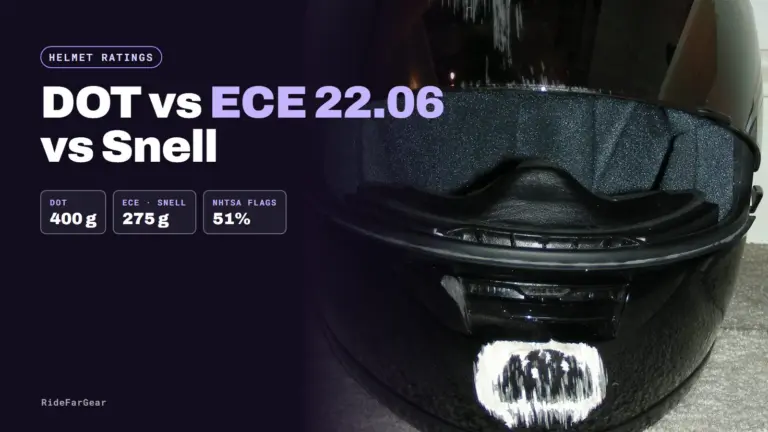
The helmet is dropped onto a flat anvil and the head stops dead. Labs measure linear g. DOT, ECE and Snell all run this test.
THE HIT MIPS IS BUILT FOR
At an angle ∠
The helmet meets the road on a slant, grips and twists the head. Researchers link that rotation to brain strain. DOT never tests it.
A rider coming off a moving bike rarely lands straight on. MIPS only works on the second kind of hit.
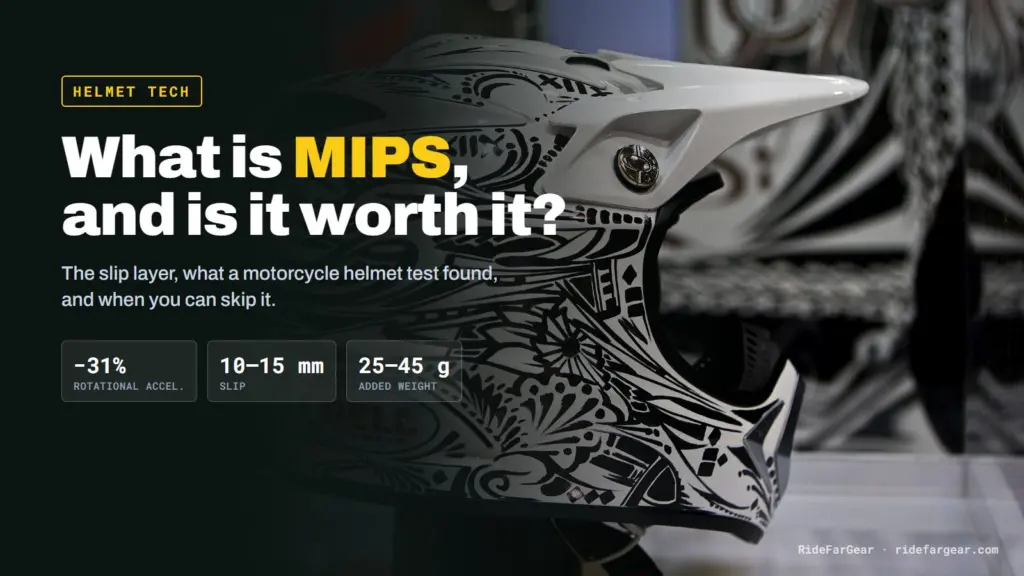
MIPS is a thin, low-friction liner inside a helmet that lets the shell and foam slide 10 to 15 mm around your head in an angled hit. That small slip is meant to cut the twisting force that reaches your brain.
Is it worth it? In the one lab study we found that tested motorcycle helmets sold both with and without MIPS, the MIPS versions cut peak rotational acceleration by 31%. The same model cost £30 more. It matters most on a DOT-only helmet, because DOT never tests rotation at all.
What MIPS is: a slip layer, not extra padding
Mips stands for Multi-directional Impact Protection System. It is a part made by a Swedish company, not a safety standard. Helmet makers license it and build it in at the factory.
Where the Mips layer sits
In a glancing hit, the shell and foam start turning with the road. The slip layer lets your head lag a few millimetres behind instead of being wrenched along at once. The foam still does the main job of soaking up the straight-in part of the hit.
The idea came from Hans von Holst, a neurosurgeon at Karolinska Hospital in Stockholm, and Peter Halldin, a researcher at KTH Royal Institute of Technology. They began working on it in the mid-1990s, and the company was founded in 2001.
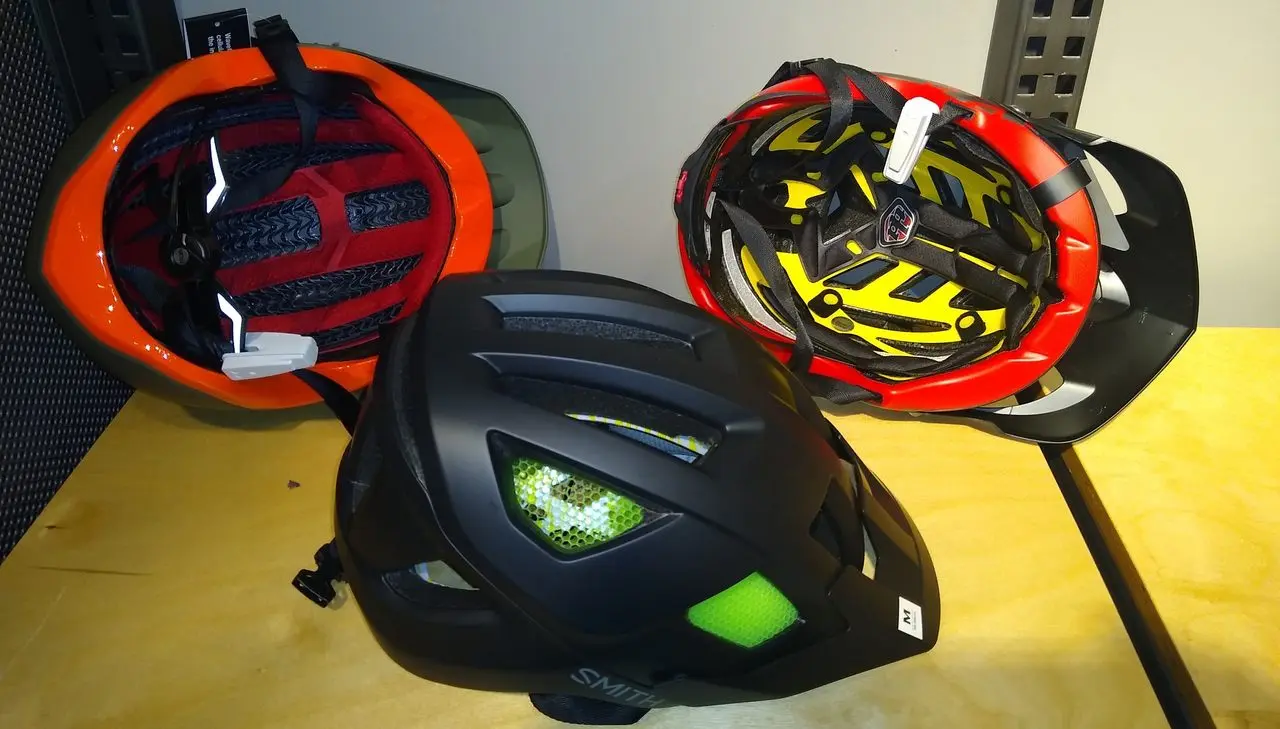
Mips’ own animation shows the layer moving inside a full-face helmet during an angled hit.
Does MIPS work? What a motorcycle helmet test found
Most MIPS research uses bicycle helmets. The exception is a 2022 Imperial College London study in Annals of Biomedical Engineering (Yu and colleagues). It dropped seven full-face motorcycle helmets onto a 45-degree anvil at 8 m/s, the oblique test from ECE 22.06, at five points around the head.
| Helmet | Rotation system | Price in the study | SHARP stars |
|---|---|---|---|
| HJC C70 | None | £150 | 5 |
| Bell Qualifier DLX | None | £180 | 3 |
| Bell Qualifier DLX MIPS | Mips | £210 | 3 |
| Icon Airflite | None | £230 | 3 |
| Icon Airflite MIPS | Mips | £260 | Not rated |
| Bell Race Star | Flex liner | £400 | 5 |
| 6D ATS-1 | ODS dampers | £550 | Not rated |
The Bell and Icon pairs are the cleanest comparison you will find: the same helmet, tested with and without MIPS. In both cases the MIPS version cost £30 more, a 13 to 17% premium.
How much lower the MIPS helmets scored
MIPS helmets vs conventional helmets, average across five impact sites. Longer bar = bigger reduction
From Yu et al., Annals of Biomedical Engineering 50 (2022), 1674–1688. Every difference shown was statistically significant.
The headline number is the one MIPS is designed for: rotational acceleration, down by almost a third. The brain-strain figures come from a computer model of the head driven by the test data, and they fell too.
The other systems did less. Bell’s Flex liner in the Race Star lowered rotational acceleration only. 6D’s ODS dampers in the ATS-1 did not beat the conventional helmets on any measure, despite the £550 price.
The case against MIPS
The evidence is good, not settled. Three caveats are worth knowing before you pay extra.
The test head may flatter it
The authors note that the dummy head they used grips harder than human scalp, which can inflate the rotation numbers. A 2021 bicycle-helmet study in Traffic Injury Prevention fitted real pig scalp to the dummy head and found no statistically significant difference between helmets with and without anti-rotation systems.
Small sample
Only two motorcycle helmets were tested in both versions, with six samples of each. The authors list that as a limit themselves.
No crash records yet
These are lab readings and brain models. We found no study of real motorcycle crashes comparing riders in MIPS and non-MIPS helmets.
Some makers take a different route. Arai does not use MIPS. It builds round, smooth shells to its own “R75” rule, a curve of at least 75 mm, so the helmet glances off the road instead of grabbing it. That is Arai’s in-house standard, and no certification test measures glancing off.
MIPS vs ECE 22.06: do you need both?
This is the part most MIPS explainers skip. ECE 22.06 has its own rotation test. Every 22.06 helmet has passed a 45-degree hit at 8.0 m/s under a rotational limit. Snell M2025 added a similar test in 2024. DOT has none.
| Labels on your helmet | Rotation tested? | What MIPS adds |
|---|---|---|
| DOT only | No | The only rotation management you get. Biggest gain. |
| DOT + ECE 22.06 | Yes, passed a limit | A way to score well under that limit. Extra margin. |
| DOT + Snell M2025 | Yes, since 2024 | Extra margin, as with ECE 22.06. |
Not sure what your helmet carries? Here is how to read the ECE label, and our full breakdown of DOT vs ECE 22.06 vs Snell.
So, is MIPS worth paying for?
Pay for it if…
- Your shortlist is DOT-only.
- The same model comes in both versions and the gap is around $30–50.
- The MIPS version fits you just as well.
Don’t stress if…
- Your helmet already carries ECE 22.06 or Snell M2025.
- The only MIPS option in budget fits worse.
- The non-MIPS helmet has a clearly better rating, like the 5-star HJC above.
Fit beats features. A helmet that shifts on your head can move on impact, MIPS or not. Check how to tell if a helmet fits before you compare liners.
MIPS also changes nothing about replacement. After a real impact, retire the helmet: the foam that took the hit does not recover. See how often to replace a motorcycle helmet.
For an independent look, Motorcycle.com walks through the system and how it is fitted.
What we read
The test results come from Yu X, Logan I, de Pedro Sarasola I, Dasaratha A and Ghajari M, “The Protective Performance of Modern Motorcycle Helmets Under Oblique Impacts”, Annals of Biomedical Engineering 50 (2022), 1674–1688, doi 10.1007/s10439-022-02963-8. The scalp study is “The effect of the scalp on the effectiveness of bicycle helmets’ anti-rotational acceleration technologies”, Traffic Injury Prevention 22 (2021), 51–56. Layer movement and weight come from Mips; its history from KTH. Arai’s R75 rule is from Arai’s own literature. Rotation tests are from the UN Regulation 22.06 text and Snell’s M2025 documents. The price gap in the decision box is our conversion of the study’s £30.
MIPS questions, answered
Is MIPS worth it on a motorcycle helmet?
Usually, if the price gap is small. In a 2022 lab study of motorcycle helmets, the MIPS versions cut peak rotational acceleration by 31% for £30 more on the same model. It matters most on DOT-only helmets, which are never tested for rotation. Fit still comes first.
Does MIPS prevent concussions?
No helmet prevents every concussion. MIPS lowers rotational acceleration and modelled brain strain in lab tests, but there is no study yet of real motorcycle crashes comparing riders in MIPS and non-MIPS helmets.
Is ECE 22.06 better than MIPS?
They are different things. ECE 22.06 is a standard with a pass-or-fail rotation test. MIPS is a part that helps a helmet score lower on rotation. Many helmets have both, and a 22.06 helmet without MIPS has still passed the rotation limit.
Can I add MIPS to a helmet I already own?
No. The helmet maker builds the Mips layer in at the factory and sizes the foam around it. It is not sold as an add-on liner.
How can I tell if a helmet has MIPS?
Look for the yellow Mips logo on the shell or the box. Inside, the classic version is a thin yellow liner under the padding. Some newer versions are built into the comfort padding and are hard to see.
Does Arai use MIPS?
No. Arai relies on round, smooth shells built to its own R75 rule, a minimum 75 mm curve, so the helmet glances off the road. No certification test measures that effect.