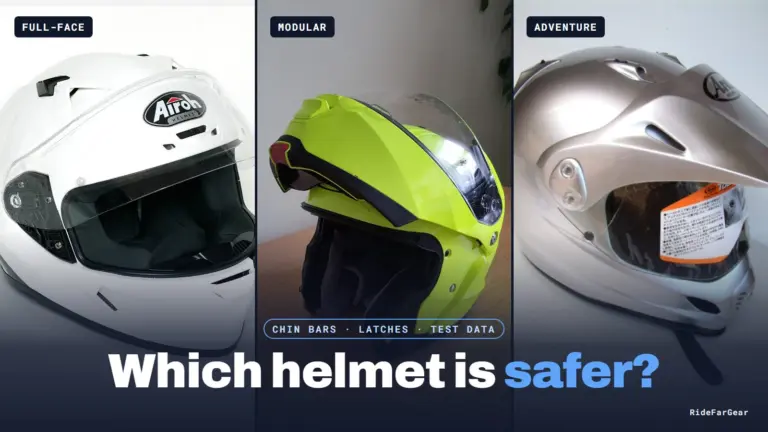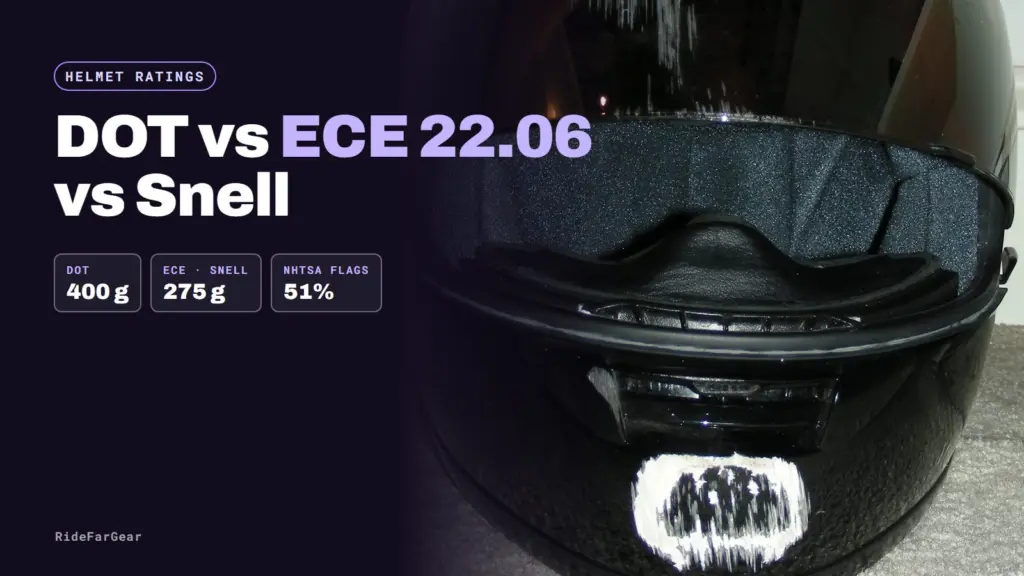
DOT, ECE 22.06 and Snell all drop a helmet onto steel anvils and measure what reaches the head. They differ in how hard they hit, what they let through, and who checks.
In short: DOT is the US legal minimum and is self-certified. ECE 22.06 tests the widest range, including rotation. Snell M2025 hits hard, twice in the same spot, and now tests rotation too.
How fast each standard drops the helmet
Linear impact speed in the certification tests, metres per second. Longer bar = harder hit
Impact energy rises with the square of speed, so ECE’s 8.2 m/s test carries about 1.7 times the energy of DOT’s fastest drop. Snell’s two hits land on the same spot. Speeds from FMVSS 218, UN Regulation 22.06 and Snell’s published figures.
peak g allowed
DOT’s limit, against ECE’s and Snell’s.
of NHTSA helmet tests flagged
385 of 752 compliance reports since 2002.
rotation tests in DOT
ECE 22.06 and Snell M2025 both add one.
Short on time?
- DOT is the floor in the US. Makers certify their own helmets, and NHTSA checks a sample.
- ECE 22.06 is the broadest test. Three impact speeds, rotation, and every position of a modular.
- Snell M2025 hits twice in one spot, and since 2024 tests rotation too.
- More labels means more testing, not a guaranteed safer helmet. Fit still decides a lot.
- Riding in the US, you need DOT. ECE 22.06 or Snell on top is a bonus worth having.
- Watch out for fake DOT stickers on novelty helmets. A thin, flexible shell is the giveaway.
On this page
DOT vs ECE 22.06 vs Snell, side by side
Here is what each label actually requires, taken from the regulation and standard texts themselves rather than marketing copy.
| DOT (FMVSS 218) | ECE 22.06 | Snell M2025 | |
|---|---|---|---|
| Who is it for | Legally required in the US | Required in Europe and many other countries | Voluntary, private foundation |
| Who certifies | The maker itself; NHTSA tests a sample | Type approval by an authority, plus production checks | Snell’s own lab |
| Linear impact speed | 5.0 to 6.2 m/s | 6.0, 7.5 and 8.2 m/s | 7.75 m/s, then 7.09 m/s |
| Peak g allowed | 400 g, plus time limits | 275 g (180 g at low energy), plus HIC | 275 g on large headforms |
| Same spot hit twice | Yes, two impacts per site | No | Yes |
| Rotation (oblique) test | No | Yes, 8.0 m/s | Yes since 2024, 8.0 m/s |
| Penetration test | Yes, pointed striker from 3 m | No | Not covered here |
| Modular helmets | No specific rule | Tested in every position (P/J) | Not covered here |
Two rows matter most. Peak g is how much deceleration reaches the head: lower is stricter. And rotation is new, because crash research attributes most head injuries to the head twisting, not just stopping.
DOT: the legal floor, and self-certified
Every helmet sold for road use in the US must meet Federal Motor Vehicle Safety Standard 218. It drops the helmet at four sites, twice at each, after conditioning it hot, cold, wet or at room temperature.
Impact
Peak 400 g, no more than 2.0 ms above 200 g and 4.0 ms above 150 g.
Penetration
A pointed striker of about 3 kg dropped from 3 m must not touch the headform.
Strap
Holds a 113 kg (250 lb) load for two minutes, stretching no more than 2.5 cm.
The catch is who does the testing. NHTSA does not approve helmets. The manufacturer certifies its own product and applies the label: “DOT”, then “FMVSS No. 218”, then “CERTIFIED”. NHTSA selects a sample each year and tests those.
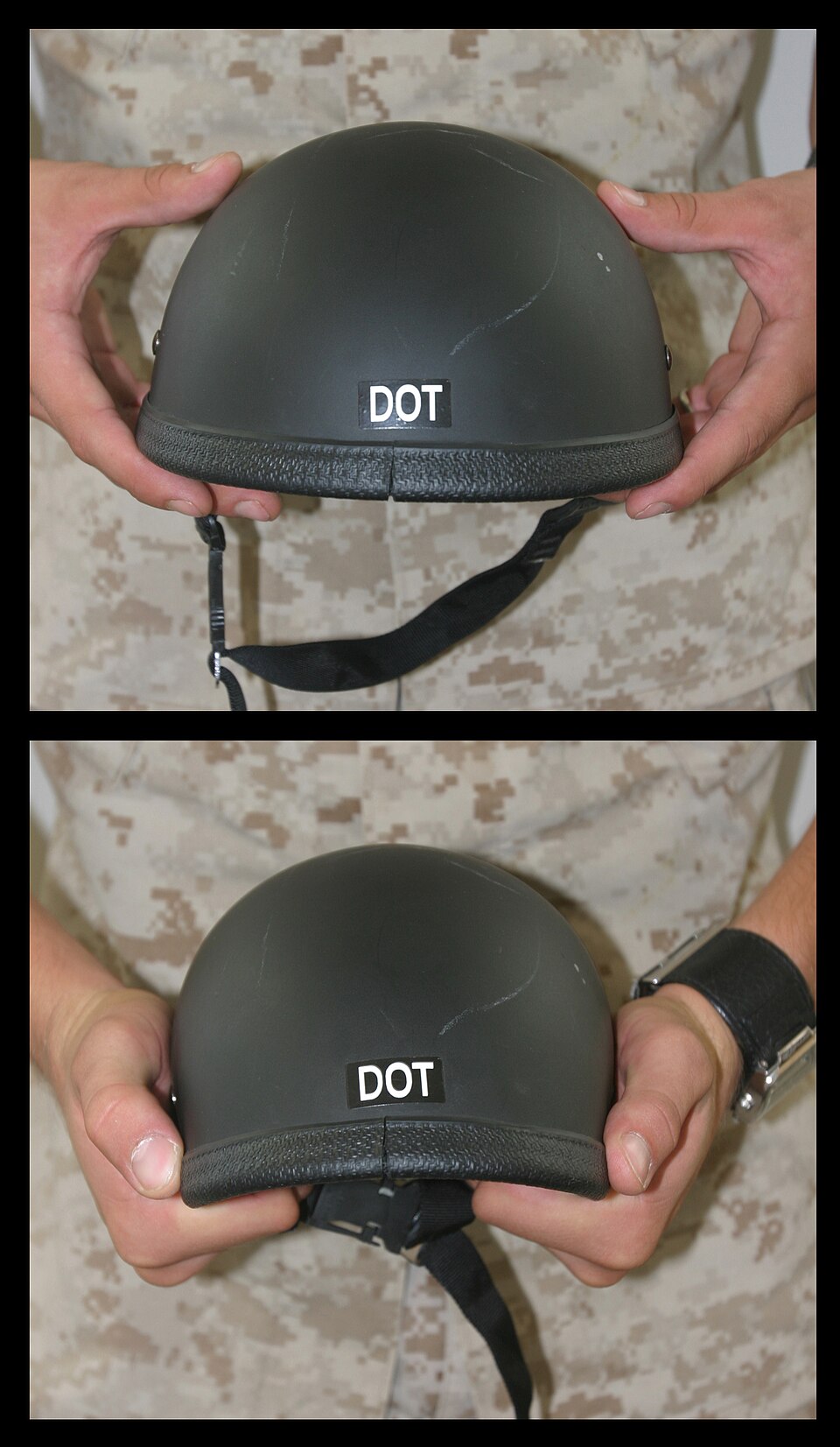
A real DOT label carries the model name above the letters and “FMVSS No. 218 CERTIFIED” below them, plus a separate label with the maker and the month of manufacture. A loose “DOT” sticker alone proves nothing.
NHTSA’s own short video shows what to look for on the label and how to spot helmets that only look the part.
What NHTSA’s own compliance tests found
NHTSA publishes every helmet compliance report it commissions. We counted all of them: 752 reports from 2002 onward. In 385, or 51%, the lab flagged an issue.
Share of NHTSA helmet tests with an issue identified
By compliance program year. Number of reports in brackets
Counted from NHTSA’s Compliance Test Report Database, duplicates removed, October 2026. NHTSA chooses which helmets to test, so this is not a random sample of the market.
Not every flag is a crash-test failure. We read the 12 most recent flagged reports, from 2025 and 2026. Nine failed a performance test: too much g, the striker reaching the headform, or a strap that let go. Three were labeling problems only.
| NHTSA’s helmet category | Reports | Issue identified |
|---|---|---|
| Partial (half helmets) | 288 | 67% |
| Full/open face | 125 | 52% |
| Complete | 332 | 38% |
| Modular | 5 | 0% |
The pattern is clear enough: half helmets were flagged most often. If you ride in the US, a DOT label is necessary, but it is not proof on its own. A second label from an independent lab is worth having.
ECE 22.06 vs 22.05: what changed, including a rotation test
UN Regulation 22.06 replaced 22.05 for new helmet approvals in Europe from mid-2022. Helmets approved under 22.05 can still be worn. On paper, 22.06 tests more often, at more speeds, and from an angle 22.05 never looked at.
| ECE 22.05 | ECE 22.06 | |
|---|---|---|
| Linear impact speed | 7.5 m/s | 6.0, 7.5 and 8.2 m/s |
| Low-speed limit | None | 180 g at 6.0 m/s |
| Rotation (oblique) test | No | 45-degree anvil at 8.0 m/s, under 10,400 rad/s² and BrIC 0.78 |
| Modular helmets | Not tested in every position | P/J helmets tested with the chin bar closed and open |
| Accessories | Not part of the test | Tested with approved accessories fitted |
| Approval number starts with | 05 | 06 |
Intercoms and cameras count too
The 22.06 text says helmets sold with accessories are tested with them fitted, and that adding non-approved accessories such as cameras or communication devices makes the approval invalid. Check that your intercom mount is approved for your helmet.
There is an honest caveat. A 2024 IRCOBI study ran 1,134 impacts on 63 helmet models and found 22.06 helmets not significantly different from 22.05 ones in head protection. The new test sets a floor; it did not transform the market overnight. Where a slip liner fits in: what MIPS is, and whether it is worth it.
How to tell if a helmet is ECE 22.06
Skip the product page. The approval is on a label, usually sewn onto the chin strap, and it reads the same way on every brand.
Example layout of an ECE approval label
E3 061234 P/J 0012345
E3 · the country that granted the approval. E1 is Germany, E2 France, E3 Italy, E4 the Netherlands, E9 Spain. Any of them is valid.
061234 · the approval number. The first two digits are the series: 06 means 22.06, 05 means 22.05.
P/J · the helmet type. P has a protective chin bar, J is open face, P/J is a modular approved both ways, and NP means the chin bar is not protective.
0012345 · the production serial number of that individual helmet.
If the approval number starts with 05, it is a 22.05 helmet. It is still fine to wear, but it was never tested for rotation or at the 6.0 and 8.2 m/s speeds. In the US, a helmet carrying this label and the DOT label is approved on both sides of the Atlantic.
Snell M2025: two hits in the same spot
Snell is a private, non-profit foundation, and its label is voluntary. Its signature test hits the same spot twice: 7.75 m/s, then 7.09 m/s, with a 275 g limit on the larger headforms.
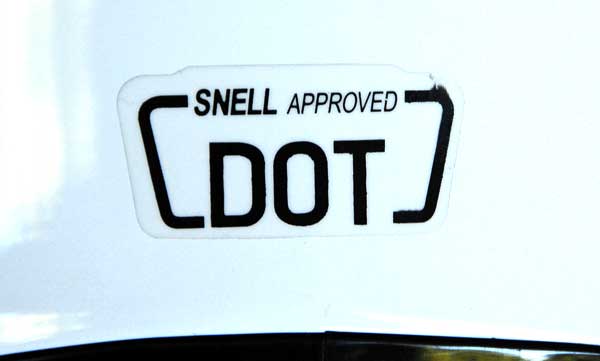
Since August 1, 2024, the current versions are M2025D, for helmets that also meet DOT, and M2025R, for helmets that also meet ECE 22.06. Both added an oblique test at 8.0 m/s, capped at 10,000 rad/s² and a BrIC of 0.78.
Snell’s own lab footage shows the drop rig and anvils used for certification.
Which label should you look for?
Riding in the US: DOT is required. Prefer a helmet that also carries ECE 22.06 or Snell M2025, so a lab other than the maker has tested that model.
Riding in Europe or touring abroad: look for ECE 22.06. A DOT-only helmet is not approved there.
Want rotation tested? ECE 22.06 or Snell M2025 are the labels that include it. DOT does not.
Choosing between certified helmets: fit matters as much as the label. A loose helmet can move on impact. See how to tell if a helmet fits.
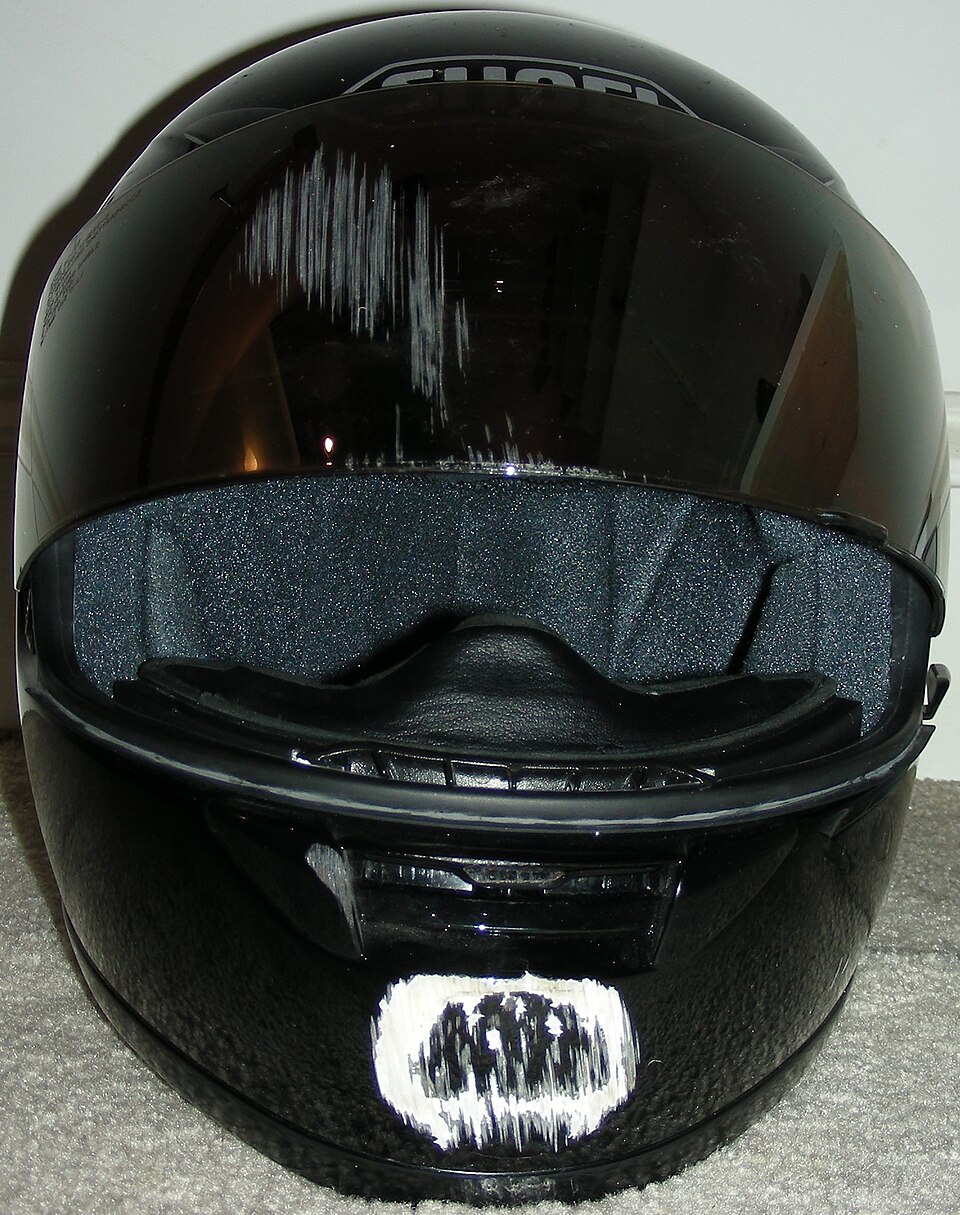
After any real impact, retire the helmet, whatever its label: the foam that absorbed the hit does not recover. Our guide on how often to replace a motorcycle helmet covers age and damage.
Before you buy: check the labels
Sources and counting method
DOT requirements come from 49 CFR 571.218. ECE figures come from the UN Regulation 22 06-series text (document GRSP/2019/25). Snell figures come from the Snell Foundation’s M2025 and K2025 documents. The IRCOBI study is Bourdet et al., 2024.
The NHTSA figures are our own count of the agency’s Compliance Test Report Database, with duplicate report numbers removed, checked in October 2026. We read the 12 most recent flagged reports in full. The energy comparison is our calculation from the test speeds.
Helmet rating questions
Which is safer: DOT, ECE 22.06 or Snell?
ECE 22.06 and Snell M2025 test more than DOT: faster impacts, a stricter 275 g limit against DOT’s 400 g, and a rotation test. DOT is self-certified by the maker. A helmet with DOT plus ECE 22.06 or Snell has been through more independent testing, but fit still matters as much as the label.
Does the government test DOT helmets before they are sold?
No. NHTSA does not approve helmets; manufacturers certify their own. NHTSA selects and tests a sample each year. In our count of its 752 compliance reports since 2002, 385 (51%) flagged an issue. NHTSA notes that a flag starts an investigation and is not a final finding.
Is an ECE helmet legal in the US?
Not on its own. Helmets sold for road use in the US must be certified to FMVSS 218 and carry the DOT label, and state helmet laws refer to that standard. Many helmets sold in the US carry both DOT and ECE 22.06, which covers you at home and abroad.
What does ECE 22.06 add over 22.05?
Impacts at 6.0 and 8.2 m/s on top of 7.5 m/s, a rotation test on a 45-degree anvil at 8.0 m/s, testing of modular helmets in every position, and checks with approved accessories fitted. A 2024 IRCOBI study found 22.06 helmets not significantly different from 22.05 ones in overall head protection.
How do I know if my helmet is ECE 22.06?
Read the ECE label, usually sewn onto the chin strap. Next to the circled E and country number is the approval number: if it starts with 06, the helmet is approved to 22.06; if it starts with 05, it is a 22.05 helmet. The letters after it give the type: P, J, P/J for modulars, or NP.
What is the difference between Snell M2025D and M2025R?
M2025D is for helmets that also meet DOT, and M2025R is for helmets that also meet ECE 22.06. Both took effect on August 1, 2024, keep Snell’s double impact at 7.75 and 7.09 m/s, and add an oblique rotation test at 8.0 m/s.
Can I still use an ECE 22.05 helmet?
Yes. ECE 22.06 governs the approval of new helmets; a genuine 22.05 helmet in good condition can still be worn. Replace any helmet after a real impact or when it reaches the age its maker recommends.
More on helmets
- How to tell if a motorcycle helmet fits
- How often to replace a motorcycle helmet
- How to stop wind noise in a motorcycle helmet
- More protective gear guides
DOT requirements from 49 CFR 571.218; ECE figures from UN Regulation 22 (06 series); Snell figures from the Snell Foundation; compliance data counted from NHTSA’s Compliance Test Report Database; study from IRCOBI 2024. Videos by NHTSA and the Snell Foundation; photos via Wikimedia Commons. Not legal advice.