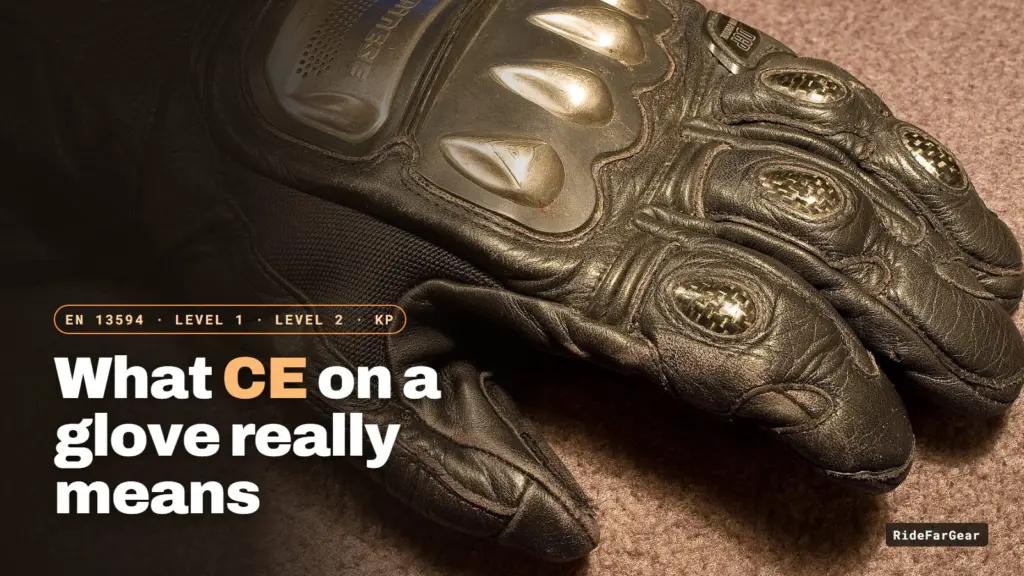
A CE-rated motorcycle glove is one tested to EN 13594:2015, the European standard for motorcycle gloves.
The label inside tells you almost everything: a motorcycle pictogram, the standard and its year, a level (1 or 2), and KP if the knuckles passed an impact test. Here it is, decoded.
levels, 1 and 2
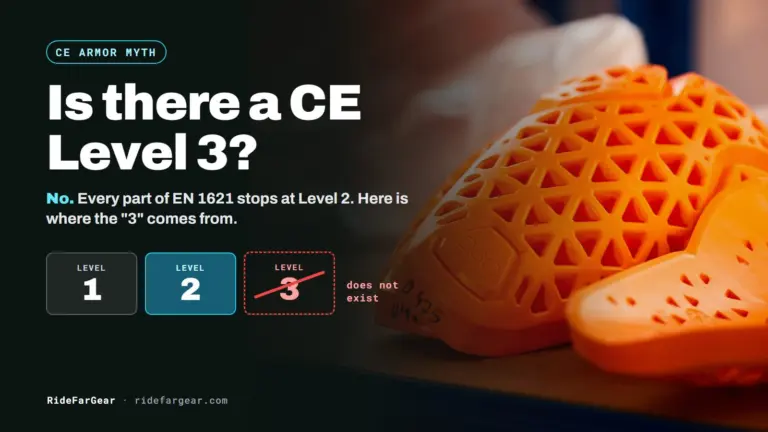
There is no Level 3. Level 2 is the top of the scale.
max average through the knuckles
To earn KP. No single hit above 9.0 kN.
minimum cuff at Level 2
Measured past the wrist line.
The main points
- Look for EN 13594:2015, not just a CE mark. CE alone does not tell you the standard.
- Level 2 is tougher on abrasion, cut resistance, cuff length and retention.
- KP means the knuckles were impact tested. Hard knuckles without KP were not.
- In the EU, motorcycle gloves are safety equipment, checked by an independent body since April 2018.
- Level 2 is not automatically right for you. It can cost dexterity and comfort.
- The standard says nothing about warmth or waterproofing. Those you judge separately.
On this page
Since 2018, motorcycle gloves are safety equipment
Since 21 April 2018, the EU has treated motorcycle clothing, gloves included, as Category II personal protective equipment under Regulation (EU) 2016/425, which replaced the old PPE directive.
Category II means an independent notified body examines the design before it can be sold. Harley-Davidson’s declarations of conformity, for example, cite EN 13594:2015 as the standard their gloves meet.
The year on the label matters. The earlier EN 13594:2002 was written for professional riders. The 2015 revision covers everyone and is the one to look for.
⚠️ “CE” on its own is not the answer
The CE mark says a product conforms to whatever EU rules apply to it. It does not say which standard. A work glove can carry CE for cut resistance. What you want is EN 13594 and the motorcycle pictogram together.
Level 1 vs Level 2: what actually changes
SATRA, one of the test houses that certifies gloves, describes the two levels plainly. Level 1 protects “while having low ergonomic penalties.” Level 2 protects more, but “may carry weight and restriction penalties.”
Here is what that means test by test.
| Requirement | Level 1 | Level 2 |
|---|---|---|
| Abrasion (palm, timed to hole) | 3 s each, 4 s average | 6 s each, 8 s average |
| Knuckle impact (KP) | Optional | Mandatory |
| Cut resistance (EN 388 method) | Palm materials only | All materials, except finger gussets |
| Retention (force to pull it off) | 25 N | 50 N |
| Cuff past the wrist | 5 mm or 15 mm (sources differ) | 50 mm |
| Seam strength | 6 N/mm | 10 N/mm |
Two rows deserve attention. Retention doubles at Level 2, so the glove is harder to pull off your hand in a slide. And the cuff must reach 50 mm past the wrist, which is what stops it riding up your forearm.
One detail most guides skip: the standard also checks the glove is safe against your skin, testing for substances like chromium VI in leather and nickel on metal fittings.
The knuckle test and the KP mark
KP stands for knuckle protection, and it is the most useful two letters on the label.
In the test, a 2.5 kg striker hits each of the four knuckles with 5 joules, on four gloves of different sizes. To pass, the average force that gets through must be 7.0 kN or less, with no single hit above 9.0 kN.
⚠️ Hard knuckles are not the same as KP
Plenty of gloves have a hard shell over the knuckles and no KP on the label. That shell might work well. It might be styling. Without KP, nobody tested it, so you cannot know which.
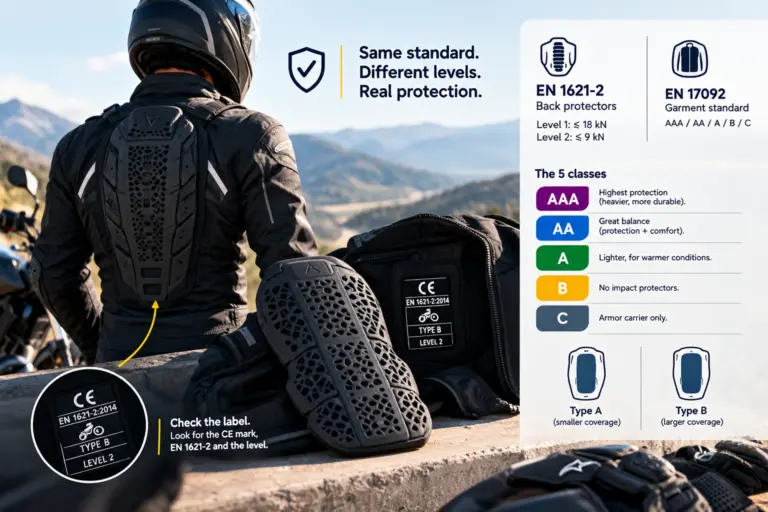
It is the same trap as the foam pads in many jackets, which look like armor but carry no certification. We covered that in do you need a CE Level 2 back protector.
KP is optional at Level 1 and mandatory at Level 2. So a Level 2 label should always show it, normally written as 2KP. A Level 1 glove with tested knuckles reads 1KP.
The abrasion test
Abrasion is tested on the palm, because that is what you put down first in a fall.
SATRA describes the method: the palm of four gloves of different sizes, lining included, is abraded on a Cambridge abrasion machine fitted with a P120 grit paper belt. Where the glove is meant to be washed, it is tested after washing.
Time before the palm wears through
Minimum average across samples
Each single sample must also last at least 3 s at Level 1 and 6 s at Level 2. Level 2 roughly doubles the time.
Jackets and trousers face their own abrasion classes under a different standard, explained in EN 17092: what AAA, AA and A jackets mean.
Where the sources disagree
Most glove guides quote figures with total confidence. When we went to the sources, three of them did not line up.
Level 1 cuff length
SATRA, a test house, says at least 5 mm. D3O, which makes protectors, says 15 mm. Both agree on 50 mm for Level 2.
Level 2 knuckle force
Several retailer guides say Level 2 knuckles allow only 4 kN. We could not confirm that against SATRA or the standard, so treat it as unverified.
The abrasion machine
SATRA names the Cambridge machine. Some guides describe a rotating drum or a Martindale tester. We follow SATRA.
None of this changes what to look for on the label. It changes how much you should trust a buying guide that quotes these numbers as if they were settled.
Is Level 2 always better?
For protection, yes. For your hands on a long day, not necessarily. The standard itself admits Level 2 can carry weight and restriction penalties.
A glove you find stiff is a glove you leave in the pannier on a hot afternoon. The best certified glove is the one you actually wear.
Level 2 makes sense for
Highway touring, sustained speed, track days. Anywhere a slide would be long and fast.
Level 1 KP makes sense for
Town riding, hot weather, and trails where lever feel and dexterity matter more.
Either way
Insist on KP. It is the one mark that proves the knuckles were tested.
Remember the standard says nothing about warmth or waterproofing. For cold-weather riding, that is a separate decision, covered in how to keep your hands warm on a motorcycle.
Check your own glove label
Tick what you can actually see on the label inside the cuff.
Checking a glove before you buy
Seven checks, in this order, in the shop or the moment the box arrives.
- Find the label. It is usually sewn inside the cuff.
- Look for EN 13594:2015, not just a CE mark.
- Check for the motorcycle pictogram. It separates riding gloves from cycling or work gloves.
- Read the level number, 1 or 2.
- Look for KP straight after it. If the glove has hard knuckles but no KP, they are untested.
- Check the cuff against your jacket. It should overlap the sleeve, not leave a gap at the wrist.
- Fasten the wrist strap and tug the fingertips. It is a rough version of the lab’s retention test. The glove should not slide off.
Sources and method
The test structure, retention forces, cut rules and cuff figures come from SATRA’s published summary of EN 13594:2015. The knuckle thresholds come from SATRA’s description of the same test method, and the striker mass and energy from published guides. Abrasion times and seam strength come from D3O, cross-checked against other guides. The regulatory dates come from the European Commission.
We have not read the full standard, which is sold by standards bodies. Where sources conflict, we say so rather than picking the tidier number. Figures checked in October 2026.
Glove certification questions
What does CE Level 1 mean on motorcycle gloves?
It means the glove passed the base level of EN 13594:2015, the European motorcycle glove standard. Level 1 is designed to protect with low ergonomic penalty. Its palm must last at least 4 seconds on average in the abrasion test, it must resist being pulled off with 25 N, and knuckle impact testing is optional. Look for KP to know the knuckles were tested.
What does KP mean on motorcycle gloves?
KP means knuckle protection, and it shows the knuckles passed an impact test. A 2.5 kg striker hits each knuckle with 5 joules, and the average force transmitted must be 7.0 kN or less, with no single hit above 9.0 kN. KP is optional at Level 1 and mandatory at Level 2, so labels read 1KP or 2KP.
Is Level 2 better than Level 1 for motorcycle gloves?
It protects more: roughly double the abrasion time, cut testing across all materials, a cuff of at least 50 mm, double the retention force and mandatory knuckle protection. But the standard itself says Level 2 may carry weight and restriction penalties. For town riding or trails, a comfortable Level 1 glove with KP can be the better real-world choice.
Do motorcycle gloves have to be CE certified?
In the EU, yes. Since 21 April 2018, motorcycle clothing including gloves has been Category II personal protective equipment under Regulation (EU) 2016/425, which means an independent notified body examines the design before sale. EN 13594:2015 is the standard makers use to show conformity. Rules elsewhere vary, so outside Europe check the label rather than assuming.
What is the difference between EN 13594:2015 and EN 13594:2002?
EN 13594:2002 was the earlier version and was written for professional motorcycle riders. The 2015 revision applies to all riders and is the version referenced by manufacturers today. If a label shows 2002, the glove was certified to the older standard.
Are hard knuckle protectors without KP safe?
You cannot tell. A hard shell over the knuckles might absorb impact well or might be mostly styling. Without the KP mark on the label, it was not impact tested to EN 13594, so there is no evidence either way. If knuckle protection matters to you, and it should, buy a glove that shows KP.
How long should a motorcycle glove cuff be?
At Level 2, EN 13594 requires the cuff to extend at least 50 mm past the wrist line. For Level 1 the sources disagree: SATRA lists 5 mm and D3O lists 15 mm. In practice, the cuff should overlap your jacket sleeve so there is no gap at the wrist when your arms are stretched to the bars.
Does EN 13594 test waterproofing or warmth?
No. The standard covers harmful substances, dexterity, sizing, cuff length, retention, tear and seam strength, cut resistance, abrasion and knuckle impact. A certified glove can still be cold or let water in, so judge insulation and waterproofing separately from the label.
More on protective gear
- What is CE-rated motorcycle armor? EN 1621 explained
- Motorcycle armor ratings explained: CE Level 1 vs Level 2
- EN 17092 explained: what AAA, AA and A jackets mean
- How to keep your hands warm on a motorcycle
- More protective apparel guides
Test requirements from SATRA’s summary of EN 13594:2015 and D3O’s published guidance; regulatory dates from the European Commission. Where sources disagree, both figures are shown. Always check the label on the exact glove you are buying.