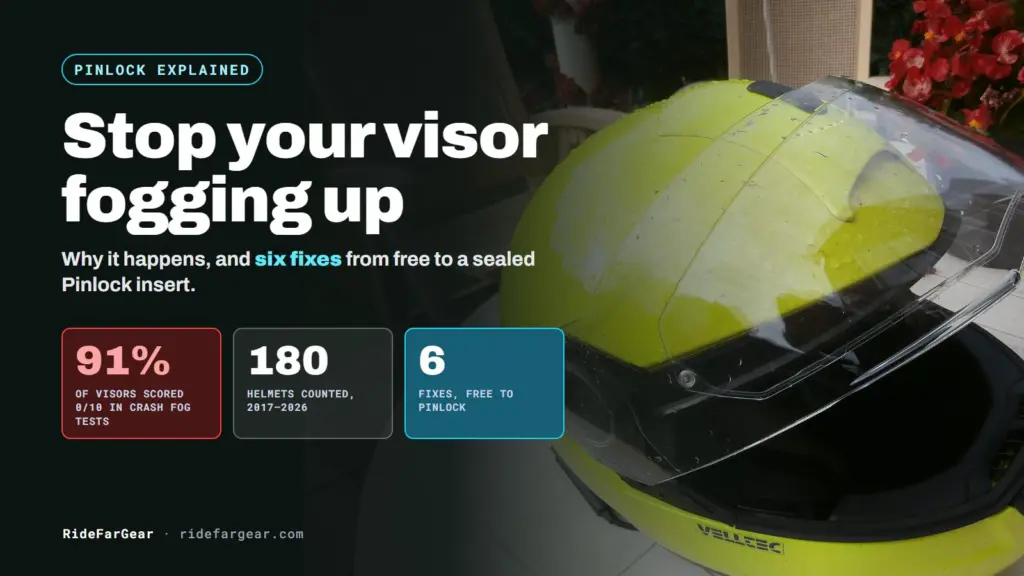
Where the fog sits on your visor tells you what is causing it. A strip along the bottom edge and a misted insert are two different problems with two different fixes.
So start with the symptom. Pick the one that matches your helmet and get the cause and the fix in one line.
DIAGNOSE YOUR FOG
Where does the fog show up?
Every one of those has the same root cause. Your breath is warm and full of water. When it touches a visor that is colder than its dew point, the water condenses into fog.
That leaves two ways to win. Keep the inside of the visor warm, which is what a Pinlock does. Or keep the breath away from it, which is what deflectors and vents do. The best setups do both.
of visors scored zero
In CRASH’s lab fog test of 180 helmets.
fog-resistance levels
30, 70, 120 and 200. Not hours, not degrees.
of paper to test the seal
If it slides behind the insert, fog will too.
What matters most
- Fog is your breath condensing on a visor colder than its dew point.
- A Pinlock insert is the most complete fix. It insulates the visor and absorbs moisture.
- The insert only works if it seals. Fog behind it means the pins need adjusting.
- Breath deflectors and vents cost nothing extra if your helmet came with them.
- Never clean an insert with alcohol or ammonia. Mild soap and lukewarm water only.
- Fog on the outside is a different problem, and no insert fixes it.
What’s covered
Why a visor fogs
Air you breathe out leaves your lungs at roughly body temperature and close to saturated with water vapor. Inside a closed helmet, it has a short trip to the visor.
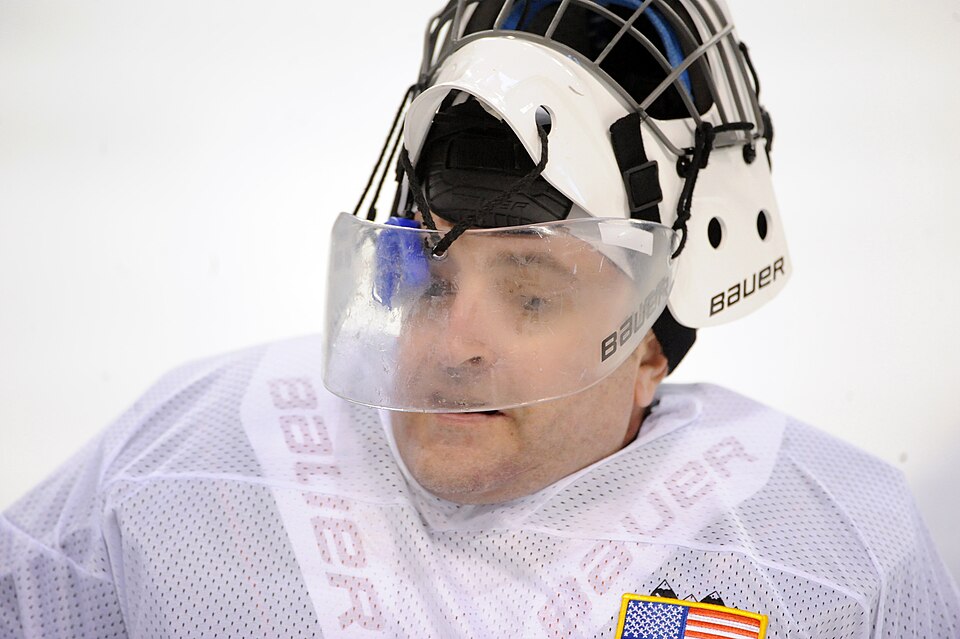
The outside of that visor is being cooled by the wind the whole time you ride. Once its inner surface drops below the dew point of the air touching it, the vapor turns into droplets. That film of droplets is the fog.
That is also why it gets worse when you stop. At speed, vents push some of that wet air out. At a red light, nothing moves it, and every breath stays inside.
How often visors fog: the test data
If your visor fogs, you are in good company. In a European survey of 598 riders, cited by the CRASH helmet program, visor fogging was the second most common complaint, behind only noise.
CRASH, the independent helmet rating program in Australia and New Zealand, also tests each helmet’s visor for its ability to resist fogging and scores it out of 10. We counted every result it has published since 2017.
Fog resistance scores of 180 helmets with visors
CRASH comfort test, score out of 10, helmets rated 2017 to 2026
91% of the helmets scored zero. Full-face, dual-sport, modular and open-face helmets with a visor, counted from CRASH’s published ratings in October 2026. Helmets without a visor are excluded.
The zeros include premium helmets from Shoei, Arai and HJC that are sold Pinlock-ready, or with an insert in the box. CRASH does not say whether inserts were fitted for the test, so read the result simply: a visor on its own fogs. The fixes below are what change that.
Six fixes, cheapest first
Work down the list. The first three cost nothing if your helmet already has the parts. Number four is the one most riders end up with.
Crack the visor to its first detent. Most visors have a small “city” position that leaves a gap at the bottom. Free, and it works at low speed. The cost is wind and rain coming in, so close it above town speeds.
Open the chin vent. It aims outside air at the inside of the visor and pushes wet air away. It needs speed to work, so it helps least at a standstill.
Fit the breath deflector and chin curtain. The deflector sits behind the chin bar and steers your breath down, away from the visor. Many full-face helmets ship with one in the box. Check before you buy anything.
Fit a Pinlock insert. The most complete fix, because it works at any speed and needs no hands. It requires a visor with pins, which we explain below.
Anti-fog spray, gel or wipes on a bare visor. They lower the surface tension of the water so it spreads into a clear film instead of droplets. They wear off and need reapplying, and they do not belong on a Pinlock insert.
An adhesive insert, for visors without pins. Products such as Fog City stick to the inside of the visor and work on a similar idea. The fallback when your helmet is not Pinlock ready.
Fixes 1 and 2 cost you some comfort. Fixes 3 and 4 are the ones you set once and forget, which is what you want on a long day.
Pinlock explained: 30, 70, 120 and 200
Pinlock is a Dutch company, and its insert is a second lens that clips inside your visor between two pins. A silicone bead around its edge seals against the visor.
That seal traps a thin layer of air, which works like double glazing on a window. The lens material also absorbs moisture, so it can take some vapor before any of it shows as fog.
Pinlock’s own one-minute video shows the idea: the sealed air gap and the absorbing lens working together.
Is your helmet Pinlock ready?
Open the visor and look at the inside, near the left and right edges. Two small studs mean yes. “Pinlock Ready” on the box means you buy the insert separately. “Pinlock Included” means it is already in there.
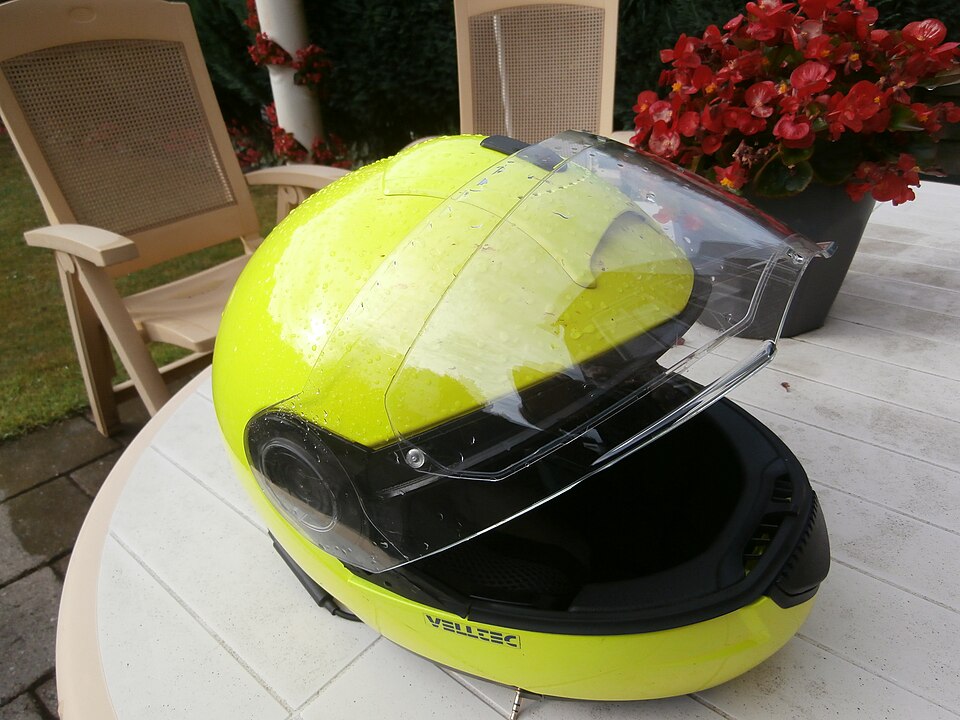
The number on the insert is the part people misread. Pinlock says it symbolizes the fog resistance level of the lens. It is not a temperature, and it is not hours of clear vision.
| Level | How Pinlock positions it | Fit |
|---|---|---|
| Pinlock 30 | Its core technology in a smaller lens, aimed at city riding | One design only |
| Pinlock 70 | The everyday level | Visor specific, MaxVision available |
| Pinlock 120 | Tested for harsh, unpredictable weather | Visor specific, MaxVision available |
| Pinlock 200 | Its top level, tested in MotoGP | Visor specific, MaxVision available |
Buy the insert for your exact visor
Except for the 30, inserts are made for specific visors, and they are listed by helmet and visor model. A close fit is not good enough, because the whole method depends on the bead sealing all the way around.
For touring, a 70 is the sensible starting point, and riders who do a lot of cold, wet miles step up to a 120. If your helmet already came with an insert, check that it seals before you replace it.
Fog behind the insert: fix the seal
If fog forms between the visor and the insert, the insert is not faulty. The seal has a gap, and moist air is getting into the space that should be closed.
The pins are the adjustment. They are mounted off center, so turning them moves the post and changes how hard the insert presses against the visor.
- Check the insert faces the right way. The silicone bead goes against the visor.
- Do the paper test. Slide the edge of a sheet of paper around the insert. If it slips between insert and visor anywhere, the seal needs more tension.
- Turn both pins by the same amount. On screw-type pins, rotate each one equally to bring the posts closer together. On push-in pins, pop them out and reseat them nearer the center of the visor.
- Test again until the paper no longer slides in anywhere.
- Keep both inner surfaces clean before refitting. A smear on the visor or the bead can stop it sealing.
Some helmets ship with a small tool for the pins, and your helmet manual has the exact method for your model. Go gently, and stop as soon as the paper test passes.
Pinlock’s fitting video shows the insert going in and the seal being checked, which is easier to follow than any written description.
Keeping an insert working
The inner surface of the insert is the part doing the work, and it is easier to damage than the visor. Treat it like a camera lens.
DO
- Mild liquid soap and lukewarm water, with a soft damp cloth
- Brush off grit with a dry microfiber first, so you do not grind it in
- Let it dry naturally before refitting
- Handle it by the edges
DON’T
- Alcohol, ammonia or abrasive cleaners
- Solvents such as benzine, thinner or gasoline
- Anti-fog spray on the insert
- Paper towels, or wiping it while it is dry and dusty
One more thing catches riders out on long wet days. The lens can only absorb so much. Once it is full, it fogs like a bare visor until it dries out again, which is normal and not a fault.
On a multi-day trip, take the insert out overnight and leave it somewhere dry. Do not take it out every day for no reason, though, because repeated removal is hard on the silicone bead.
Cold weather makes all of this worse
The colder the air, the colder the visor, and the further it sits below the dew point of your breath. That is why a helmet that never fogs in summer can blind you on the first frosty morning.
Fogging is a safety problem, not a comfort one
It tends to strike when you slow down, which is exactly when you are reading junctions and traffic. If your view goes, open the visor and pull over. Then sort out a fix that works without your hands.
Cold-weather gear can add to it. A neck gaiter pulled up over your nose channels your breath straight up into the helmet. Keep it below the chin bar, and let the chin curtain close the gap instead.
Keeping the rest of you warm is the other half of a cold ride. We cover that in how to layer riding gear for cold weather and how to keep your hands warm.
Before a cold or wet ride
Our sources
The fog levels and lens descriptions come from Pinlock’s own product pages. Cleaning rules come from Pinlock’s lens maintenance manual and Shoei’s Pinlock instructions. The seal adjustment follows SportsBikeShop’s fitting guide. Fog scores come from CRASH‘s published helmet ratings, counted by us, and the rider survey is the one CRASH cites.
Pinlock does not publish what its numbers measure, so we do not convert them into hours or temperatures, and neither should anyone else. Checked in October 2026.
Fogged visor questions
How common is motorcycle visor fogging?
Very common. In a European survey of 598 riders cited by the CRASH helmet program, fogging was the second most common helmet complaint after noise. In CRASH’s own fog test, 163 of 180 helmets with visors scored zero out of 10, including premium models. A Pinlock insert or a good breath deflector is what changes that.
How do I stop my motorcycle visor fogging up?
Keep the inside of the visor warm, keep your breath away from it, or both. A Pinlock insert insulates the visor and absorbs moisture, which is the most complete fix. A breath deflector, chin curtain, chin vent and the visor’s first detent all help too, often at no cost.
Why does my Pinlock fog up between the insert and the visor?
The seal has a gap. The silicone bead should seal the space between insert and visor all the way around. Slide a sheet of paper around the edge, and if it slips in anywhere, turn both eccentric pins by the same amount to add tension until it no longer does.
What do Pinlock 30, 70, 120 and 200 mean?
They are fog resistance levels. Pinlock says the number symbolizes the fog resistance level of the lens, with 30 aimed at city riding and 200 as its top level. The numbers are not temperatures or hours. The 70, 120 and 200 are made for specific visors.
Can I use anti-fog spray on a Pinlock insert?
No. Pinlock’s maintenance instructions limit cleaning to mild liquid soap, lukewarm water and a soft damp cloth, and rule out alcohol, ammonia and abrasive products. Sprays are meant for bare visors without an insert.
Why does my visor fog when I stop but clear when I ride?
At speed, the vents move wet air out of the helmet. At a standstill nothing moves it, so each breath stays inside and condenses on the visor. Cracking the visor to its first detent as you slow down is the quick fix, and a Pinlock insert removes the problem.
Why is my visor fogging on the outside?
The visor is colder than the humid air around it, for example when you ride out of a cold garage or the bike sat outside overnight. An insert cannot help because it only works on the inside. Wipe it, and it clears as the visor warms up.
More on helmets and comfort
- How to stop wind noise in a motorcycle helmet
- How to tell if a motorcycle helmet fits
- How to reduce wind buffeting
- More comfort and ergonomics guides
Fog test scores from CRASH helmet ratings; videos by Pinlock; photos via Wikimedia Commons. Fog levels from Pinlock’s product pages; cleaning from Pinlock’s lens maintenance manual and Shoei’s Pinlock instructions; seal adjustment from SportsBikeShop’s fitting guide. Always follow the manual for your own helmet.