You do not need scales to know you have overpacked. The bike tells you.
Find your symptom below and you will usually find the cause sitting in the wrong piece of luggage.
| What the bike is doing | What is usually causing it | The fix |
|---|---|---|
| Weaves or wanders on the highway | Weight too high and too far back | Move dense items out of the top case, down into the panniers |
| Feels top-heavy at walking pace | Tall load above the seat line | Lower the center of the load, strap bulk forward instead of up |
| Wants to lean one way | Panniers uneven in weight, not volume | Weigh them by hand and swap items until they match |
| Twitchy under braking | Rear-biased load unweighting the front | Shift mass forward, tank bag and front of the panniers |
| Something creeps backward as you ride | Straps not tensioned, or a load with nothing to push against | Re-cinch hard, add a strap across the back of the load |
| You are exhausted after 4 hours | Fighting an unbalanced bike all day | All of the above. Fatigue is the real cost of bad packing |
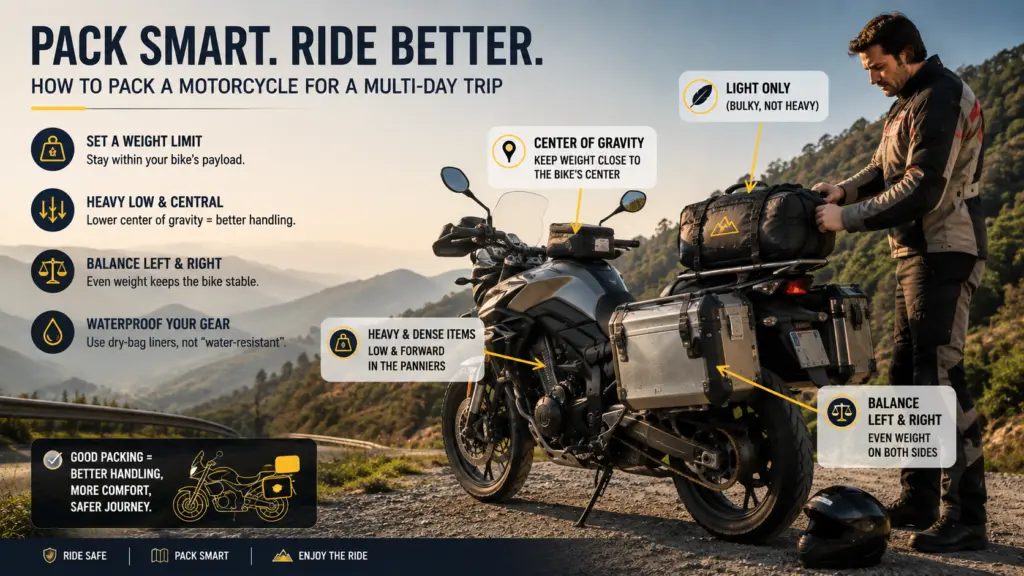
The whole answer to packing a motorcycle for a trip without ending up top-heavy fits in one sentence: set a hard weight limit first, keep the heaviest items low and close to the bike’s center, and be honest about the difference between what you will use and what just makes you feel prepared.
The rest of this guide is the system that makes it repeatable.
typical payload rating
180-200 kg for rider, gear and passenger combined.
what is left for luggage
20-30 kg once you subtract yourself in full gear. Less than most assume.
number worth checking
Payload or GVWR, in your owner’s manual. Most riders never look.
The short version
- Set a weight budget before you touch your gear, then remove a third of the pile.
- Heavy goes low, light goes high. Panniers for dense items, top case for bulky-but-light.
- Split weight evenly left and right so the bike does not lean one way.
- Pack a clothing system, two or three rinseable base layers, not a fresh outfit per day.
- Waterproof from the inside with a dry-bag liner. Do not trust “water-resistant”.
In this guide
Why overpacking is a handling problem, not just a comfort one
Weight on a motorcycle is not neutral. Where you put it changes how the bike steers, brakes and recovers.
Load a top case with heavy tools and you raise the center of gravity exactly where it hurts most: high and far back. The bike feels top-heavy at low speed, gets twitchy under braking, and wanders when the wind picks up.
There is a safety cost too. A tired rider makes worse decisions, and fighting an unbalanced bike for eight hours is genuinely tiring.
Packing light is not minimalism for its own sake. It is about arriving at the end of a long day with judgment to spare. If loaded touring is new to you, a rider course from a group like the Motorcycle Safety Foundation is worth the day it takes, and the fatigue side is covered in how to ride long days without getting exhausted.
Start with a weight budget, not a packing list
Before you pull out a single item, decide how much you are willing to carry.
Stay well under your bike’s rated luggage and payload limits, which live in the owner’s manual. Most riders never check this. You should.
To put rough numbers on it: a typical mid-size adventure bike has a payload rating, for rider, gear and passenger combined, of somewhere around 400 to 450 lb (180 to 200 kg). Subtract your own weight in full riding gear and you are often left with just 40 to 70 lb (roughly 20 to 30 kg) for luggage and everything in it.
Payload calculator: will your load fit?
Use the figures from your owner’s manual or the sticker on the frame, often near the steering head. Weigh yourself in full riding gear.
STEP 1 · YOUR BIKE’S LIMIT
STEP 2 · WHAT YOU ARE ADDING
Accessories count against payload too. A crash bar set runs about 3.6 to 4.9 kg (8 to 10.8 lb), an aluminum skid plate about 3.4 to 3.7 kg (7.6 to 8.25 lb).
🎒 The one-bag test
Everything except camping gear and tools should fit in a single medium dry bag or one pannier. If it does not fit, you are not packing for the trip, you are packing for anxiety. Lay it all out on the floor, then remove a third. You will not miss it.
Where weight goes on the bike matters most
Two bikes can carry the same 20 pounds and handle completely differently depending on placement. The goal is low and central.
| Location | Best for | Keep out |
|---|---|---|
| Panniers (low, both sides) | Tools, spares, liquids, anything dense | Nothing, this is where heavy belongs |
| Tank bag (low-mid, central) | Phone, wallet, snacks, a light layer | Heavy hardware |
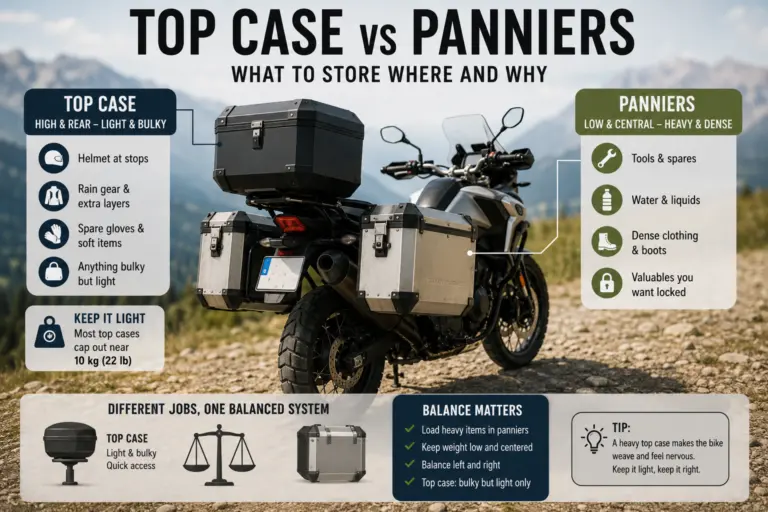
| Top case (high, rear) | Sleeping bag, rain gear, helmet liner | Your tool roll, water, anything dense |
Which case takes what is worth its own look, and we went through it in top case vs panniers: what to store where and why.
Riding two-up or without a top case?
Carrying a passenger changes the math. They take the seat and add weight high and to the rear, so move your own gear lower and forward to compensate: dense items into the panniers, bulk onto the tank and front.
If your bike has no top case, a tail bag or rack pack strapped over the pillion seat does the same job. Keep it to light, bulky items and cinch it down hard so nothing creeps backward under braking.
What to actually pack for a multi-day trip
Here is the framework, organized by function. Notice how little there is. That is the point.
✓ Pack this
- 2-3 rinseable merino base layers
- Tire plug kit + inflation
- Spare clutch & brake lever
- Compact power bank + one multi-tip cable
- Docs in a waterproof pouch
✗ Skip this
- A fresh outfit for every day
- Full-size toiletries
- Tools your riding buddies already carry
- “Might need it” spare cables
- Gear for weather that is not forecast
Clothing: a layering system, not outfits
Do not pack a fresh outfit per day. Pack a system: a base layer, a mid layer for warmth, and your riding gear as the outer shell.
Two or three moisture-wicking base layers you can rinse in a sink go further than a week of cotton. Merino is worth it, because it resists odor for days. The cold-weather version of this is in how to layer riding gear for cold-weather touring.
How few clothes you actually need is a question of its own, answered in minimalist motorcycle packing: what to actually leave behind.
Tools and spares: enough to get moving again
You are not carrying a workshop. You are carrying enough to fix what actually strands riders.
A tire plug kit and a way to inflate, the specific tools your bike needs for roadside basics, a spare clutch and brake lever, zip ties, and strong tape. That covers most trip-ending problems without the weight. The plug kit side is covered in how to fix a flat tire on the road.
Electronics: chargers, not gadgets
A phone, a charging cable, a compact power bank, and the mount you already run. Resist the pile of “might need it” cables, because one multi-tip cable covers most of it.
Documents and essentials
License, registration, insurance, a card and some cash, and any medication. Keep these in a waterproof pouch in your tank bag, the one place you can reach without unpacking anything.
Camping gear (only if you are sleeping out)
If you are camping, this is where discipline matters most. A compact tent, an inflatable pad, and a packable sleeping bag rated for the coldest night you expect.
These are the big, light items that belong high and rear, not the heavy ones. What you genuinely need is in motorcycle camping for beginners.
Packing techniques that save space and stress
- Roll, do not fold. Rolled clothes take less space and wrinkle less. Compression sacks squeeze soft items down further.
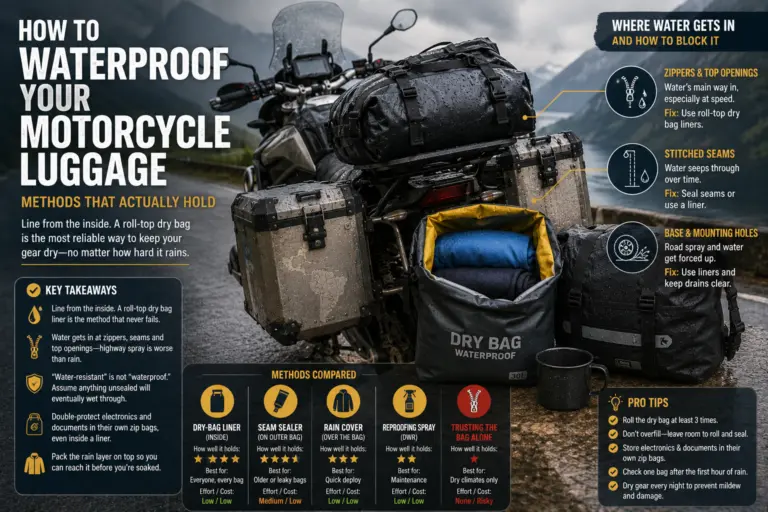
- Waterproof from the inside. Do not trust “water-resistant” luggage in real weather. Line bags with a dry bag so gear stays dry even if the outer bag does not. The full method is in how to waterproof your motorcycle luggage.
- Pack by frequency. Things you need at every stop go on top or in the tank bag. Camp gear you only touch at night goes to the bottom.
- Balance left and right. Uneven panniers make a bike lean-happy on one side. Weigh them roughly by hand before you ride off.
Pre-ride balance checklist
Run through this the moment before you throw a leg over. It takes 30 seconds and catches the mistakes that ruin the first hour.
Packing questions riders actually ask
How much weight can I safely carry on a motorcycle?
Check your owner’s manual for payload and luggage limits, which account for you, your gear and any passenger together. A typical mid-size adventure bike rates somewhere around 400 to 450 lb (180 to 200 kg) in total, leaving roughly 40 to 70 lb (20 to 30 kg) for luggage once you subtract yourself in full gear. Most riders overload the rear rack long before they hit the total limit, so placement matters as much as the number.
Should heavy items go in the top case or the panniers?
Panniers, every time. They sit low and close to the bike’s center of gravity, which keeps handling predictable. Reserve the top case for bulky, lightweight items like a sleeping bag or rain gear, and respect its load limit, which is often about 10 kg (22 lb) however many liters it holds.
How do I keep my luggage dry in the rain?
Line the inside of your bags with a dry bag or waterproof liner rather than relying on the outer material. Even luggage sold as waterproof can leak at seams and zippers under sustained rain and highway spray, because riding into weather at speed forces water through gaps at pressure.
What is the one thing most riders overpack?
Clothing. A layering system with two or three rinseable base layers replaces a suitcase of daily outfits and frees up an entire pannier. Three sets on a wash rotation covers a trip of any length, so a ten-day trip needs the same clothing as a three-day one.
How do I know if my bike is overloaded?
The bike will tell you before any scale does. Weaving or wandering on the highway means weight is too high and too far back. A top-heavy feel at walking pace means the load sits above the seat line. Wanting to lean one way means the panniers are uneven in weight rather than volume. And being unusually tired after a few hours is the clearest sign of all, because you have been fighting the machine.
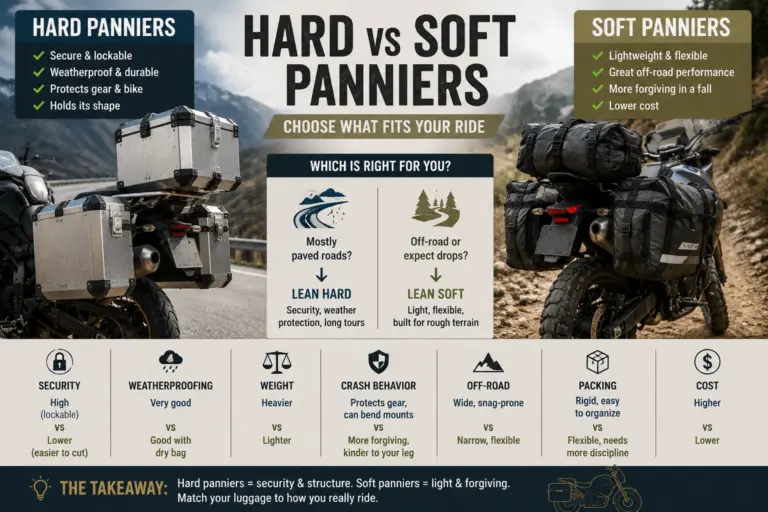
Want to dial in your setup further? Compare hard vs soft panniers, sort out what goes where, or browse all our luggage & storage guides.