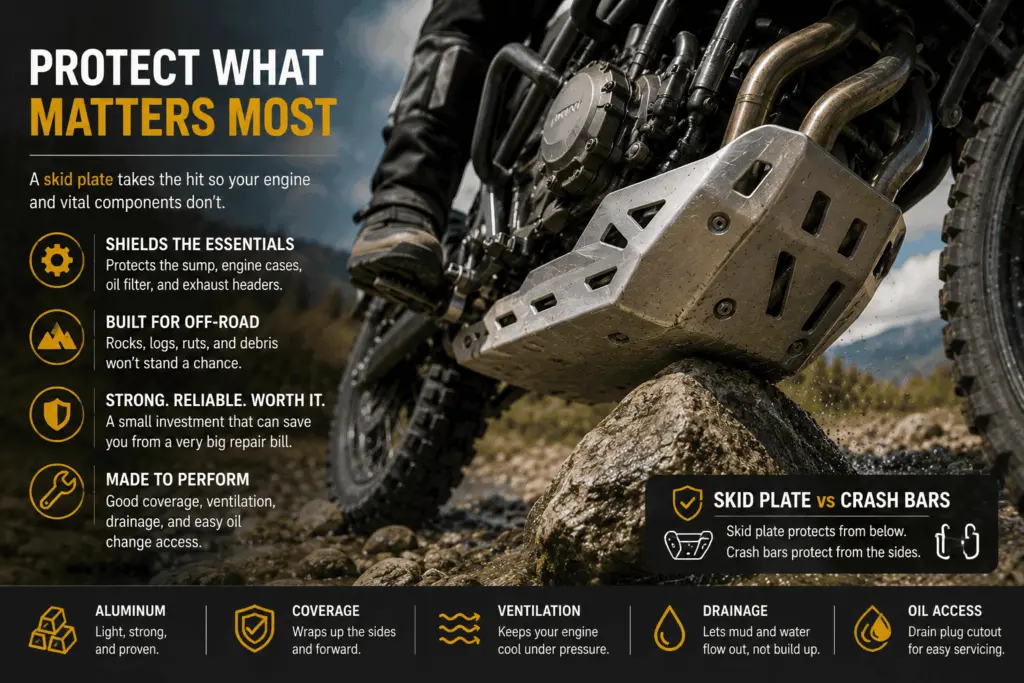
You need a motorcycle skid plate if you ride anywhere the ground can reach your engine: gravel, forest roads, trails, rocks and ruts. It is the shaped shield bolted under the motor that takes a strike from a rock or a log so your sump, engine cases, oil filter and exhaust headers do not. Pure pavement riders can skip it. The moment you leave tarmac it moves from nice-to-have toward essential, and the thin tray many bikes ship with usually does not count as one.
What matters most
- A skid plate protects the engine from below. Crash bars protect it from the sides. Neither replaces the other.
- “Bash plate” means two different things, the thin cosmetic tray fitted at the factory and, in British and European usage, a real skid plate. The word tells you nothing, so look at the thickness.
- Real numbers: aftermarket aluminum plates run 4.0 mm to 4.8 mm and weigh 3.4 kg to 3.7 kg (7.6 lb to 8.25 lb). An 8 mm HDPE plate weighs around 1.5 kg (3.3 lb).
- HDPE is 30 to 40% lighter than aluminum, it is much quieter, and it slides over logs where aluminum tends to dig in.
- Coverage matters more than thickness. A plate that only covers the flat bottom leaves the sides of the cases and the headers exposed.
- Check how it mounts. Several points across both frame rails beats a bracket hanging off one side, and the best designs let the bracket stay on the bike during oil changes.
On this page
What a skid plate is
A skid plate, also called a bash plate or a sump guard, is a shaped shield that bolts under the engine and frame. When the bottom of the bike meets a rock, a log or a hard rut, the plate takes the blow and slides over the obstacle instead of letting it punch into the motor. On anything but smooth roads the underside of a motorcycle is remarkably exposed, and the parts down there are among the most expensive to repair.
What it protects
Sump & cases
A holed crankcase or cracked cover strands you and costs a fortune. This is the failure you are buying the plate for.
Oil filter
Exposed and fragile on many bikes. A single strike here dumps your oil on the trail.
Exhaust headers
Low header pipes are thin-walled and sit forward of the sump, so they get crushed by rocks the plate never touched.
Rear linkage
On many bikes the shock linkage sits low behind the engine. Some plates extend to cover it, most do not.
Skid plate vs bash plate: the word that means two things
This is where riders lose money, so it is worth being precise. “Bash plate” gets used in two completely different ways and neither is wrong.
In British and European usage, bash plate is simply the normal word for a skid plate, a proper protective shield. In the way most manufacturers label their own bikes, the stock “bash plate” is a thin tray fitted for appearance and light spray, not for stopping a rock. Same two words, opposite levels of protection.
The practical rule is to ignore the name and look at two things: thickness and how far it wraps. A cosmetic tray is thin, flat, and bolts to a couple of tabs. A real plate is 4 mm or more of aluminum, or 8 mm of HDPE, sweeps up the sides and forward, and bolts to solid frame points. If you are about to ride off pavement, get under your bike and check which one you actually have.
⚠️ The 30-second test
Push up hard on the middle of the panel under your engine with your thumb. If it flexes, it is a cosmetic cover. If it does not move at all, it is doing a job. Then look at it from the front: if you can see the sides of the engine cases past the edges of the panel, those sides are unprotected whatever the panel is made of.
Why coverage beats thickness
Riders shop for skid plates by millimeters, and thickness is the easier number to compare. Coverage is the one that decides whether you get home.
Rocks on a trail do not arrive straight up from directly beneath the sump. They come from ahead and from an angle as the front wheel kicks them back, and they catch the forward edge of the engine, the sides of the cases, and the header pipe. A thick flat panel covering only the bottom face is protecting the one area least likely to be struck by anything sharp.
Materials and what the makers actually publish
These figures are taken from manufacturers’ own specifications rather than retailer summaries, which is the only honest way to compare.
| Material | Typical thickness | Published weight | Behavior on a hit | Best for |
|---|---|---|---|---|
| Aluminum (6061) | 4.0 mm to 4.8 mm | 3.4 kg to 3.7 kg (7.6 lb to 8.25 lb) | Dents and stays dented, keeps working. Transmits noise and can dig into obstacles. | The default for adventure touring |
| HDPE plastic | 8 mm | About 1.5 kg (3.3 lb) | Flexes and springs back, slides over logs, no ringing noise. | Weight-conscious riders, technical trails |
| Steel | Thinner for equal strength | Heaviest of the three | Toughest against sharp, concentrated strikes. Rust needs managing. | Hard enduro and repeated abuse |
| Stock cosmetic tray | Thin pressed plastic | Negligible | Cracks on the first real impact. | Looks, and light road spray |
Two things in that table surprise people. The first is how little a plate weighs relative to the worry about it, roughly 3.5 kg (7.7 lb) in aluminum, which is less than a full fuel can. The second is that HDPE is not the budget option, it is a different set of trade-offs. It is quieter because it does not ring when struck, and the plastic slides across a log where an aluminum edge tends to bite.
As with crash bars, no skid plate carries a certification you can check. There is no standard, no test and no rating, so published thickness, material and mounting design are the only comparable signals you get.
Do you actually need one?
It depends on where your wheels spend their time.
Yes: off-road and ADV
Trails, rocks and ruts make an impact a question of when, not if. Close to essential, and get one that covers the headers.
Probably: gravel and light dirt
Forest roads fling debris and hide the occasional rock. The oil filter is the part worth protecting here.
Not really: pure street
On smooth pavement there is little for the plate to do. Save the weight and spend it elsewhere.
What to look for
A good plate is more than a slab. These are the design details that separate the ones worth fitting, and they are all visible in the product photos if you know what you are looking at.
Mounts to both frame rails
Several points spread across both sides, not a bracket hanging off one. AltRider’s plates use a four-point mount with M8 stainless bolts across both rails, which is the pattern to look for.
Wraps up and forward
Coverage of the case sides and the header pipe, not only the flat bottom. Formed bends rather than welded corners also resist deformation better.
Cutouts for heat
The engine still needs airflow. Good plates include cutouts so heat can escape rather than sealing the motor into a tray.
Drains mud and water
A plate that holds mud becomes dead weight you carry for the rest of the day. Drain slots keep it clearing itself.
Service access
The best designs leave the mounting bracket on the bike during an oil change, so routine maintenance does not mean removing the whole plate.
Rubber isolation
Shock-absorbing bumpers between plate and engine reduce both the transmitted shock and the drumming noise a hard-mounted plate makes.
The problems a bad plate creates
A skid plate is not a free upgrade, and a poorly chosen one introduces faults the bike did not have. Nobody selling plates leads with this list.
❌ What goes wrong
- Trapped heat. A sealed tray around an air- or oil-cooled engine raises running temperatures.
- Trapped mud. A plate with no drainage fills up and you carry the weight all day.
- Single-side mounting. A bracket bolted to one case can load that case in an impact instead of protecting it.
- Drumming and vibration. A hard-mounted aluminum plate rings, and the noise is genuinely tiring on a long day.
- Hidden leaks. A full-coverage plate catches drips, so a weep you would have spotted on the ground pools out of sight.
✅ How to avoid it
- Choose a model-specific plate with cutouts, not a universal panel.
- Check there are drain slots at the lowest point.
- Insist on mounting points across both frame rails.
- Look for rubber bumpers between plate and engine.
- Pull the plate occasionally and look inside, which is also when you check the bolts.
That last point matters more than it sounds. A plate hides the underside of your engine, and the ground is normally where you notice a leak first. Add a look under the plate to your pre-trip routine, alongside the rest of the checks in roadside repairs you should be able to do.
Skid plate vs crash bars
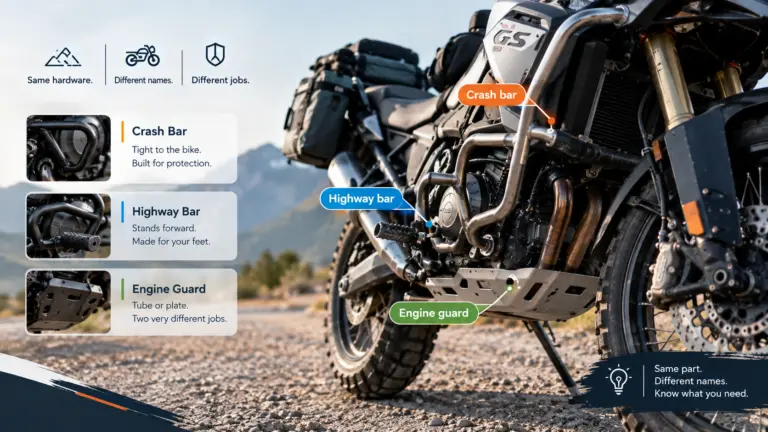
These two get confused constantly, partly because some brands sell the plate under the name “engine guard” and others use that phrase for the tubular bars. They do different jobs and work best together. A skid plate guards the bike from below. Crash bars guard it from the sides in a drop or a tip-over. Neither replaces the other.
The naming really is a mess, and we untangled it in crash bars vs highway bars vs engine guards.
Skid plate
Rocks, logs and debris hitting the engine from underneath, mostly off-road. Protects sump, filter and headers.
Crash bars
The engine and bodywork in a sideways drop or tip-over. See what crash bars actually protect.
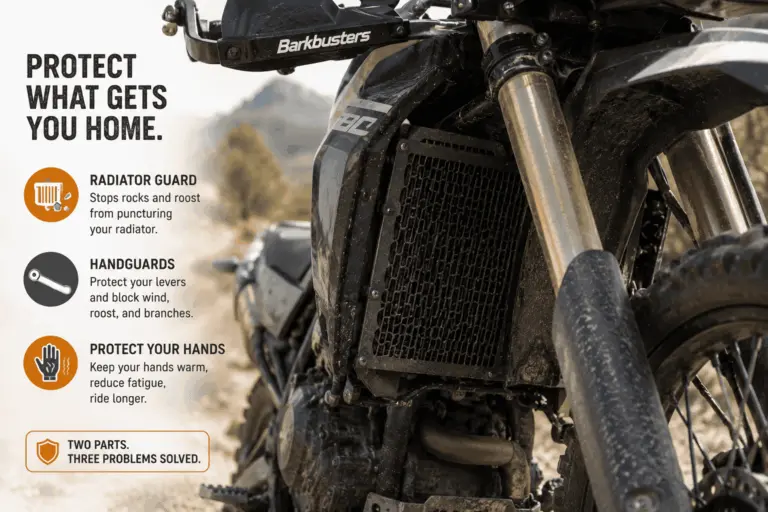
Most adventure riders heading somewhere remote run both, plus guards for the radiator and the levers, which we covered in protecting your radiator, levers and hands on rough trails. Remember the weight adds up, and it all counts against the load budget described in how to pack a motorcycle without overloading it.
Quick check before buying
Where these facts come from
Thicknesses, weights, alloys and mounting details were read from AltRider’s published specifications for individual motorcycles and from AXP Racing’s HDPE plate specifications, rather than from retailer descriptions. Figures were checked in September 2026 and vary by motorcycle, so confirm the numbers for your exact model before ordering.
Where this guide departs from the usual advice is on coverage over thickness, and on the list of problems a plate can cause. No skid plate carries a certification you can verify, so design details are the only comparable evidence available.
Skid plate questions
What is the difference between a skid plate and a bash plate?
In British and European usage they are the same thing, two words for a protective shield under the engine. In the way manufacturers label their own bikes, the stock “bash plate” is usually a thin cosmetic tray rather than real protection. Because the word is used both ways, judge by thickness and coverage instead: 4 mm of aluminum or 8 mm of HDPE that wraps up the sides is a real plate, and a thin flat panel on two tabs is not.
How thick should a motorcycle skid plate be?
Aftermarket aluminum plates are typically 4.0 mm to 4.8 mm, with 4 mm being the common standard. HDPE plates run around 8 mm because the plastic needs more section to do the same job. Steel can be thinner for equal strength but is the heaviest option. Coverage matters more than an extra half millimeter, so a 4 mm plate that wraps up the case sides beats a thicker one that only covers the flat bottom.
Is the stock bash plate good enough for off-road?
Often not. Many bikes ship with a thin pressed cover that is effectively cosmetic and will crack on the first real impact. Push up firmly on the middle of it with your thumb: if it flexes, it is a cover rather than protection. Then look from the front and see whether the sides of the engine cases are visible past its edges, because those sides are what angled rocks actually hit.
Aluminum or HDPE skid plate, which is better?
They are different trade-offs rather than better and worse. Aluminum at around 4 mm is the adventure touring default, roughly 3.4 kg to 3.7 kg, and it dents while continuing to work. HDPE at 8 mm is 30 to 40% lighter, around 1.5 kg, much quieter because it does not ring when struck, and it slides over logs where an aluminum edge can bite. Aluminum suits loaded touring, HDPE suits weight-conscious and technical riding.
How much does a skid plate weigh?
Published figures for aluminum adventure plates run about 3.4 kg to 3.7 kg, or 7.6 lb to 8.25 lb, depending on the motorcycle. An 8 mm HDPE plate is nearer 1.5 kg, about 3.3 lb. That is less than most riders expect, roughly the weight of a full fuel can, and it sits low on the bike where added mass matters least.
Can a skid plate cause overheating?
It can if it seals the engine into a tray with no airflow, which is more of a concern on air-cooled and oil-cooled motors. Well designed plates include cutouts specifically so heat can escape. Choose a model-specific plate with ventilation rather than a universal flat panel, and check that mud is not blocking the cutouts after a wet ride.
Does a skid plate replace crash bars?
No, they protect different directions. A skid plate shields the engine from below against rocks and debris. Crash bars protect the sides in a drop or tip-over. Confusingly, some brands sell plates under the name “engine guard” while others use that phrase for the bars, so check the photo rather than the name. Riders heading somewhere remote typically fit both.
Do I need a skid plate for street riding?
Usually not. On smooth pavement there is very little for a skid plate to protect against, so it mostly adds weight and hides the underside of the engine from view. It becomes worth fitting the moment you ride gravel, forest roads or trails, where rocks and debris can strike the engine from below.
Where to go next
- What crash bars protect, and what they don’t
- How to protect your radiator, levers and hands on rough trails
- How to fix a flat tire on the road (plug kits explained)
- How to pack a motorcycle for a multi-day trip without overloading
- More bike protection guides
Thickness, weight and mounting specifications read from AltRider and AXP Racing manufacturer pages, verified September 2026. Specifications vary by motorcycle and revision, so confirm the figures for your exact model and year before ordering.